Saturday, 24 August 2013

Summer Camp Begins


Elke and I are here in Cameroon to assist in running the BetterWorld Summer Camp.

 Day one and we revisit the schedule, posting on stickie notes each activity, re-arranging them to maximize our time on the land. Nothing like a visual aid to organize one's thoughts. The camp attendees drift in slowly over the next week, a few are in and out with other more compelling responsibilities that have them missing chunks of the program.
The camp's presentations and information sessions are being held in a ground floor apartment, in a higher end part of town, although it's hard to tell from the roads.
 The "campers" sleep there and we have our meals together. No furniture so Sonita brings some chairs from the office in a couple of taxis...

We introduce ourselves and spend some time determining what everyone has to offer, what they are expecting.
 An introduction to Council Circle, The Four Agreements and basic communication understandings get us going.


Our first work day at the farm, we all pile into  a taxi. Obviously the rates aren't enough because each time we are jammed in tight with more people than I deem safe. I finally say no when the driver has someone sharing his seat as well as the 5 people in the back and 3 on the front passenger seat of a Toyota Tercel, the standard taxi here.

On arrival our first exercise is observation.
Everyone finds a spot to draw their map from. I try to inventory all the trees I see from the edge of the cleared area. It really is too much. I'm unable to differentiate the different palms yet, along with a number of other unfamiliar trees  interspersed among the rows of corn and cassava all interplanted with beans, sweet potato...It is a big list. I try a different tack from another angle.
 Elke calls us all back and we discuss the exercise, I'm not alone in feeling overwhelmed, but we all have better sense of being there.


Next we descend the slope into an even denser, lusher area where there are some seedlings that we'll be planting out.


 Up the hill and measuring the approximate mature span of the eventual crown size these trees will produce determines how far apart to plant along one edge of the cleared area and into the swales below.


As we head over to the next planting spot it begins to rain. Someone pulls some ripe ears of corn and we decamp to the shed where a fire is quickly built and the ears roasted. The rain comes down, Hard.

 Big drops and intense, one can barely see the women who continue to work, making beds to be planted later, each covered with a large white bag one side slit to make a raincape.
They do eventually join us, soaked to the skin to dry out and have a roasted corn snack just before we head back to town.

Monday, 12 August 2013

First Visit to Bafut

Nothing happens quickly here, except the taxi rides: one minute we're standing at the side of the road and the next hurtling through oncoming traffic dodging potholes, pedestrians and other taxis going in both directions either side of the road.
This after visiting the office of  Better World Cameroon where the "bamboo" man Pius, was waiting for us.  While Joshua fielded phone calls and email, Elke conferred with Sonita about the program. After an introduction, Pius waited patiently beside them listening carefully to everything they said.
Then we took that aforementioned cab ride to the "bamboo" man's house along roads that reminded me of washouts I'd hesitate to bicycle into.
 Welcomed into his home he showed us examples of his work; panels for walls and ceiling, a chair and a small briefcase his son had produced: no metal, even the locking mechanism made from this "bamboo"
With a word to his daughter lunch appeared in front of us. The hospitality here has been impressive, local food and lots if it. Plantain, boiled this meal, with chicken in a delicious tomato hotsauce. So much for losing weight here...
Another cab ride, this time with extra passengers. We were wedged in tightly 4 in the back and ! 4 in the front! 2 small children but still...The police were obvious standing at the side of the road. Apparently this is a "toll" road. Our driver must have paid earlier, we weren't stopped.
From one cab into another and down a red, red eroded slippery road to Bafut. We stop at a booth and pick up a bottle of Palm Wine. Fizzy and sweet like Ginger Beer only mildly alcoholic. We trek in to the Ndanifor Permaculture Eco-Village  site and are blown away by how much has been accomplished. Terraced, swaled hillsides, a cleared area for the buildings,  bananas,  numerous trees and cassava, ginger, corn, Taro, palm oil trees, pumpkins, sweet potato and more, both ready to harvest and just emerging. The soil enriched by a constant source of mulch/compost from the prolific growth of... everything! Little tree nurseries here and there, a riot of green, ferns, palms....it's the jungle......
The "bamboo" turned out to be Raffia-Palm wands/stems (for lack of a better term) the business end of the palm frond. A solid chunk of fibre about  as big around as my arm and 3-6 metres in length. Beside the building site large bundles stacked and waiting for the plan, some leaning up against a tree like tipi poles.
I was reminded of Eden, a veritable paradise of food plants with a climate to match. Walking out I thought about my permaculture lessons- that's how it's done. Interplanting, succession and stacking, nothing wasted, moisture stored in the rich soil...
We picked up a jug of Palm wine, walked out to pavement and another high speed taxi ride took us back to the apartment.

Friday, 9 August 2013

Descending into Bemanda the bus pulls around and to the left a waterfall dropping unimpeded for about 60 metres, a slow white arc against the green of the mountainside. On the right the city spreads out up to the hills ringing it.
Like many bus stations we've been to recently the "driveway' is dirt and mud. After exiting the bus we  carefully retrieve our belongings. I take on my backpack and Joshua's in front (actually nicely balanced) while he finds us a cab. I'm lost immediately as the driver takes left turns, right turns and proceeds along streets towards our destination.
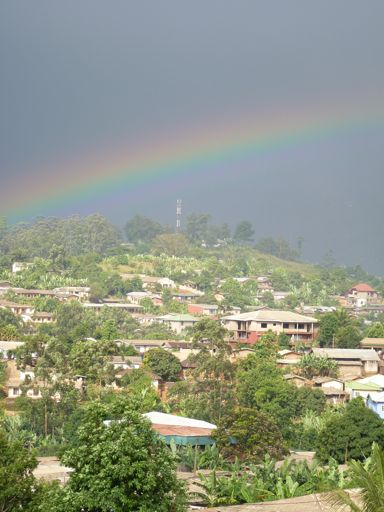
 From the balcony later I spot the waterfall and determine it is to the south and east of our present location. A thunderstorm erupts off in the distance, immense black clouds crossed with a rainbow.
That evening we are led down a narrow alley in the dark to be welcomed officially by the Board of Better World Cameroon. They called us brother and sister, many hugs and handshakes, new names and introductions.
  Prayers had been said to assure our safe arrival as we came through the air and overland by bus. A short speech of welcome, and then the meal. Being the guests of honour we're served first. Rice with vegetables, fried plantain in strips, greens with little white flecks (ground melon seed)and chicken.
The host and Board chair brings out a bottle of ...  German style beer brewed here in Cameroon (since 1759 it says on the bottle) and then everyone else fills their plates. A major grace spoken with much reference to Jesus and then the toasts. We are told the tradition of serving the patriarch the chicken's gizzard and yes I ate every morsel. 
Energized by a delicious meal  Elke speaks, introducing herself and her work. My turn and I speak about education, men's work and my role working with Elke. How our intention is to support the creation of a Better World.
Aware that we have been traveling for the last three days our hosts encourage a short evening and we head back to the apartment proceeding flashlight in hand to fall asleep to the sounds of the nightclub below, the honking of taxis and motorcycles from the street out front.

Thursday, 1 August 2013

Travelers

I'm sitting in the Istanbul airport, drinking a Turkish beer, when a fellow takes the seat beside us. A burly hunk of a guy, he wants to know where we are from. When we ask, he's Turkish and on his way to  a kickboxing competition in Thailand.
Across from me at another table  I watch an older Oriental lady sipping beer and fanning herself. There is something quite elegant or regal about who she might be. The airport is full of milling,  shopping people of all descriptions. We blend in easily, two more travelers bound for somewhere else with no desire to visit or actually purchase anything in the "Duty Free"
No, we have enough stuff already.
In the lounge for our flight a young couple, white, among all the black faces, each speak to us. They are Cameroonian residents, working in a school in Yaounde, both born in Africa, she speaks with an Illinois accent. Super friendly and offering much info about Cameroon I'm struck again by the reality of actually being somewhere as opposed to  reading the warnings from the state department on the net.
My experience of people everywhere is that they are friendly.  A stern or seemingly unfriendly stare or gaze is often disarmed with a simple hello. And, placing oneself in challenging or compromising situations puts you at risk . Obviously.
On the bus to Bamenda I take a seat at the back so I can sit more comfortably. The guy beside me is huge and intimidating looking. I offer my hand to shake and he shares his trouble sitting in the cramped seats. His two boys perched beside him stare unashamedly at me for most of the trip.

The terrain is a visual feast; dense jungle looks like a lot of trees and undergrowth, the occasional plantation of banana, oil palm or coconut completely engulfed by the vines and miscellaneous greenery that seems to take about a week to reassert itself. Along the road to Yaounde there were smashed (usually front end) abandoned cars about every 5 km interspersed occasionally with trucks like dead animals, their wheels in the air, in the ditches and rolled down the banks. No buses thankfully.
Many of the towns along the way have speed bumps along with disrepair and considerable gaps in the road (pot hole does not begin to describe them) which, depending on how adroitly our driver swerves, has me airborn or looking down at the ground. That and the near misses of passing vehicles drives me to reading my e reader. That is when I'm able to focus on the jerking screen.
When we stop halfway (maybe!)  the food vendors are all over us  Most can speak some English, pidgin and French so we are able to understand... mostly.  Cassava in a long sausage shape, roasted plantain,
a peanut or pistachio paste wrapped in a banana leaf with hot spices and a  small purple eggplant looking fruit I saw in the trees that's roasted then eaten cold. Try and find that at home!

Friday, 19 July 2013

Willow weaving

When I left Canada/Vancouver Island I had recently begun to investigate and embrace basket weaving. An encounter with Cedar and the Sacred Grandmother left me wishing for more... instruction, knowledge and understanding.

I created, with help, (Thank you Maria and Sacred Grandmother Cedar) a basket from the branches and bark of one of the last tipi poles I ever harvested. It felt right to be utilizing all of her, working the branches into a usable if primitive carrier.


My research determined that there were still Basketry schools in Germany and France, plus a number of museums and a culture in Europe that supported the artisans who grow, harvest and create with willow.

Willow is the historic and quintessential material here, from the ubiquitous shopping basket to wood carriers, baby carriages, bread holders, fishing creels, laundry baskets and the beach basket chairs lining the seashore and beaches all over Germany. From fencing to hats and split for the finest of work, willow works well.

So I wanted an immersion, an introduction and download of as much information as I could assimilate. The museums unfortunately were closed all winter and I wondered "How was I going to get it?"
In the spring the local castle in Blankenhain hosts a basketry display and plant sale where the numerous examples of utility and whimsy excited my passion again.
A flyer from the Deutsches Fletchwerk Association had me surfing the net, writing to contacts and somewhat excited about German weaving terms: more vocabulary!  Then I got onto the British weaving websites and things really began to move for me. I contacted Mary Butcher to purchase her book Willow Work.
In response to my request for an English speaking instructor Hansgert and Ursula Butterwerk invited me to spend 3 days at their home and workshop.
I knew I was truly and completely there when on arrival I saw many bundles or 'bolts' of willow withes or 'rods' leaning up beside the back door, willow soaking in long tubs and green willow upright in water, roots formed and leaves sprouting.

 Inside a chaotic (to me) assembly of power tools, started projects, bending jigs and more willow along with cane, rattan and likely a whole lot of material I didn't recognize. 

The Butterwerks also manage a basketry museum including a a studio/workshop and gallery where local artists display their works and create cultural events. A former weaver's residence,  the museum documents the rise and fall of basketry in Dalhausen village. Old photographs and small dioramas illustrate how the people lived and worked with willow. The tools, benches and pictures, along with many examples of the types of baskets they produced, are spread throughout the building. The journey through is well organized and with Hansgert guiding I received an incredible amount of relevant information in the short time we were there.


For the next three days I was immersed in the culture of willow; talking, working and examining as I made  willow circles, then bottoms: the base or 'slath' of a basket in brown (with bark) and white (without). The smell of those wet rods took me back ... I don't know where, but it was familiar, very familiar from long ago.


One evening we piled into the car and headed north to Rheder (Brakel) where the locals had harvested willow into bundles and under the direction of a Swiss architect created an outdoor willow "building" or pavilion earlier that spring. I had dreamed of someday doing something like that.
Each day I managed to create a number of samples under Hansgert's able and friendly direction. He was generous with advice, and happily described his work and projects he was engaged in creating. Ursula popped in and out daily, working her shift at the Museum as well as producing gourmet meals for us. She and Hansgert met at the Basketry College in Lichtenfels.
By the last day I was close to full. I completed a simple yet complex bread basket in white willow that one starts upside down then turns inside out, slowly tightening the rods together in threes.
Still excited, still committed to learning more, I filled my cup. I'll have room for more at another time.

Adventure

Adventure
It has a nice ring to it, images of slogging through lush grass across a wide vista, entering a darkly dense forest following barely discernible trails and scaling some rocky crag.
 Or fill in the blanks from your own memory banks!
I was brought up thinking adventure involved chasing some dream or illusive entity across varied landscapes with or without companions...The Hobbit, Lord of the Rings and numerous manifestations of travelogue and fantasy tale have kept me "armchaired" for years. I hardly imagined I could participate in such endeavors, until I met Elke. She was living it, with little fanfare, no corporate sponsorship and humility that awed me. My first thoughts? "I want to do that!"
On reflection I realize that my life has always been an adventure, one's definition of what is important, valuable and relevant determines the path chosen, who we associate with and the choices we make day to day. I chose a long time ago to "not be normal" whatever that was. It is who I am today, a character, enigmatic and predictable, both in my moral sense and commitment to truth, my desire to create and support change and consciousness transformation towards  community based (tribal) reality. To me that sounds like adventure.
So here we go again or really still. A continued procession toward whatever end is in store for me/us down that road of time and experience. Next stops; Hamburg, Berlin then Cameroon.
I read somewhere long ago that once the nest is empty and the work is done our role is to move to service, to forgo the material pleasures of permanent residency, puttering in the back 40 and acquisition of goods. I cannot claim much success in this but I am moving in that direction. My bell collection quietly stored with books and kitchenware back in Canada as I move toward a nomadic, minimalist existence providing service how ever, when ever and where ever possible.
 I feel a tremendous need to have a good memory here, to have access to the collected knowledge distilled to wisdom through years of experience. I judge I am woefully unprepared! And in the moment what works, where we are, is what needs to happen. Living in the moment, now that is adventure!

Wednesday, 2 January 2013

Thoughts on clothing from the bus

The polyester leisure suit is alive and well in Tanzania. Well maybe thread worn and stained, but holding it's own among the more well to do in the rural population at least. On the bus to Kondoa our conductor looks dignified and official in his faded lime green affair. Numerous older men step on, wedging themselves in deeper, immaculately dressed in matching jacket and trousers. Any wonder? The dust and dirt here is enough to get a Maytag salesman drooling. Too bad electricity is in such short supply although they've put up the power poles into the village (Mnenia) recently...

The women seem committed to the maximum visual effect, colourful kangas and kitenges draped over their shoulders, covering their hair and of course in layers as skirts. The one exception to my generalized observation would be the Maasai. The men mostly (we only occasionally see the women) dress in layers of shukas, brightly patterned woven fabric in plaids of  blue and red, green and yellow and flourescent orange and red...(yes!) or all of the above, together. Which cannot  begin to describe what it looks like.  

These Maasai herdsmen stand at the side of the road, seemingly miles from anywhere in blue and red plaids with their ever present staff/stick/cane, watching their livestock eke out some sustenance from the (what looks like) non existent vegetation. But this year is an initiation year and many of those young herdsmen are dressed in black. Completely in black, every item of clothing black. Except their faces, white foreheads with various permutations of design and expression on the cheeks in white face paint, ash likely or flour. A few have ostrich feathers shooting up from behind their heads, black of course. As we drive by they stare more intently than I dare to. Out of respect for their process I took no pictures.

Meanwhile in the cities their elder brothers walk up and down the streets, cell phone in hand decked out in colours many women would be challenged wearing.  On their feet the famous Maasai sandal; a chunk of motorcycle tire with a piece coming up between the toes; a beaded fringe waving saucily in the air. Although the ubiquitous running shoe/sneaker/training shoe  (I'll name no brands) seems to be making inroads, pardon the pun.


Back on the bus in rural Tanzania, if you can get a seat, there will likely be someone sitting beside you. If a woman,  she'll be constantly fiddling with her head scarf, tucking it here, pulling it out there, occasionally disappearing from view. Possibly to sleep or at least avoid any eye contact with this heathen infidel. The men are usually more friendly, their suits staining sweat right through to their jackets. Asking in their best English where I'm from and for how long, and expressing incredulous surprise at where I'm living.  Almost every man wears the Islamic hat called taqiyah or kofia. Occasionally a ball cap and rarely a fedora. 

 The availability of western clothing is remarkable (at least to my naive mind) For 10,000 Tanzanian shillings one can purchase a bale of clothing, jam packed into a metric cube that when opened -stand back!- will overwhelm one with such a variety of shirts, pants and underwear to possibly jade one forever from ever wanting to wear the stuff. T-shirts with every imaginable slogan, endorsement or "witty" saying, adorning folks who have no English,  no idea what it says. Cheap though, thanks to the folks who donated these dated, discarded derelicts of a disintegrating culture to the land of all our ancestors.

 This is globalization in action,  the few folks  still wearing traditional clothing fast becoming anomalies in a rapidly moving, corporate driven, pathological push towards  uniformity.

 No thanks! I had  a shuka made into a shirt and a kanga into pants. Bring on creative dressups!