Showing posts with label Bafut. Show all posts

Sunday, 25 December 2016

Christmas in Kenya

 Dec 24
At the moment I’m staying in an A-frame surrounded by second growth trees in some of the last remaining indigenous forest in Nairobi Kenyas’ environs. A few moments ago there was a large Sykes monkey sitting on the balcony peering at us from the railing. Long tails and a huge hairy brow. They are quite entertaining jumping through the tree tops, chasing each other. The dogs barking their heads off while the monkeys run up and down the vines and trees beside the house teasing them. If we leave a window open for the cats, and bananas on the counter? Bananas gone. Yesterday I was sitting doing my writing and I hear the window moving open, then a face peers under the blind. Cheeky!
It’s a tremendous relief to be away from the instability and potential violence we experienced last month in Bamenda. It was challenging to  focus on anything with random gunshots , tear gas and protests happening. We were already intending to leave, so it seemed appropriate to accelerate our departure since we had a destination and accommodation waiting. Putting out the word to friends and associates we were able to give away and sell  all our furniture and household goods, recovering some of our investment. A bonus really. And all done long before the arranged ride arrived. Floors mopped, bags packed and waiting at the entrance.
It was a bitter sweet departure. We made some good friends in Bafut, some friends were out of the country and others we hadn’t contacted before leaving. The threat of more troops arriving, unknown outcomes and more protests anticipated,  encouraged us to cut short our stay, and move on to our next adventure. One of the German volunteers accompanied us to Dschang where there is a famous museum. The other volunteer was there already staying with a friend and raving about how friendly everyone was. A college town with a lakeside promenade beside the museum, it was quite a contrast.
Then onto Douala by bus. The proprietor of the hotel drove us in the morning to the depot where numerous touts attempted to “assist” us into their company’s bus. I watched them accost a number of arriving women on motorcycles, quite aggressively. The women were not impressed. Eventually we left after a few false starts, entertained by a salesman flogging herbal remedies, standing in the aisle at the front of the bus exhorting everyone to try his samples. After some time he got off and not long later another fellow stepped on and did a repeat performance.
Douala’s a busy place, international seaport and airport, a real cross-roads of cultures. We spent time walking near the hotel, breakfast at a roadside stall every morning, a pizza in the Greek/Lebanese restaurant on our last night. We had a driver from a previous visit and he gave us a tour of the town. Through the port authority; massive warehouses,  lines of waiting workers, stacked containers and seafood restaurants, then the old part of town past impressive architecture, hotels and residences. Lots of very old street trees, mostly mangoes.
 Then into the main market, a more chaotic and crowded place, I’ve never been. Negotiating through intersections spilling over with produce, people and intense smells we inched through, the market itself stretching in all directions beyond sight. Trucks disgorging endless boxes of goods manhandled and hand-trucked back into the market from blocks away where there was somewhere to park. Intense.
In the morning a Christmas parade had us leaving early to avoid the blocked streets, through the airport and onto our plane… practically empty. We managed to score the exit seats, lots of leg room and they cancelled the scheduled stop in Yaounde so we arrived an hour early. The view was clouds the whole way until I saw Lake Victoria!   Our ride arrived after Elke had arranged sim cards so our internet connection is set.

Wednesday, 16 March 2016

A Water Catchment Project

In my volunteer work I’ve chosen to use my growing photography skills to document some of the events and occurrences for Better World Cameroon. At the moment we are focussed on  a water catchment project.
From a small trickle of sweet and dependable water that we were  barely able to access, the eventual intention is to have it filtered, contained and then pumped up to the kitchen and dormitory. As Ndanifor Permaculture Ecovillage is meant to be a community resource and learning centre, the local Regent of Bawum was approached and he pledged the community’s support.
 Every mutanibaa ( the day after country Sunday, a community work day) one “quarter” of Bawum (one of the Fondoms within Bafut) sends a group of folks to help.  Both women and men bring hoes, shovels and cutlass to clear land, dig and clear mud from the channel as we slowly approach the source of our spring.
 The major thrust of work has been at the end of the dry season. Our intention, as project leader Joram Shu has stated, is to get below the water table, deep into the earth where the water source appears to be.
The first week’s group of people worked long and hard, from a muddy track on the surface to a ditch a metre and half deep more than 50 metres long descending into the valley bottom. Through topsoil down into a grey clay that had building manager Elke Cole expressing interest for plaster.
The women pulled muddy slop downhill continuously, opening up the channel while at the head of the excavation the men burrowed into the hillside, deeper and deeper.

Strong young (and occasionally older) men lifted great, wet slabs of clay up and over their heads onto the edge of the ditch, There someone would either pick it up by hand, hoe or shovel and throw it onto an ever increasing pile.
The second week we had women carrying large rocks down for the filter bed and cistern, on their heads, and in their arms. Young men had brought wheelbarrow loads of sand and gravel anticipating the eventual creation of each piece of the system. However the digging continued. After cutting right at 90 degrees chasing the water our flow had increased to 4+ litres a minute.
This week the flow from the  right hand turn had diminished and seemed to be coming directly below a raffia palm.
With more excavation, the channel deepened and the flow increased. Everyone in the ditch, now over two metres deep near the source, comes out covered in grey slip.

After 3 sessions of hanging about the edge I felt it was time to take my camera into the heart of the experience. Most of the community had left so I knew I wouldn’t be getting in the way.
Unfortunately, lacking experience and having a large lapse in judgement, I neglected to note the depth of mud, the narrowness of the ditch,  and the risk to the camera. I did manage to get some footage, grey walls grazing the lens, as I slowly sank deeper and deeper into the soft and grasping clay, one foot disappearing almost to my knee. No purchase on the sheer and slippery walls.


Unwilling to proceed and get both legs swallowed up, I had a hard time turning myself in the canyon like passage. Extracting the one foot while maintaining balance meant the camera made contact with the wall.Yuck! Covered almost completely in grey clay slip I pulled myself out and lay the camera in the sun, while I went for cleaner water to at least wash my hands.


From now on I’ll remain the observer. I have some footage, interviews and a record of the progress. When the project is completed I intend to create a video. It will be a celebration and acknowledgement of community involvement and support in the creation of natural resources; human and environmental. Offering possibilities for the community.

Follow the progress in the Facebook album

Monday, 25 January 2016

Funeral -redefined


We were invited to a burial this weekend. Not a funeral. The uncle of a close friend,  one of the last of the elders in his family had passed . He had been a big man in the community, well liked  and a significant influence supporting many members of  his village to go on to become educated.
Our friends, the daughters, nephews and cousins went off to the village of Mankwi early in the day to do preparations. A group of us volunteers shared a taxi and made our way off the pavement and into the mountains behind Bafut. The narrow road was dusty with occasional large rocks and a few potholes, squeezing to the side as an occasional taxi or truck roared past.  The views were majestic, through some seemingly unharvested forest, infrequent houses and a great valley falling away below to the mountain across the way,  eroded and scalped by the locals preparing to grow crops once it starts raining again.
Arriving in the village the road was plugged with pedestrians, parked buses and cars. Most folks dressed in their finest clothes, some in ceremonial robes and all the family we knew, wearing one fabric. As well there were choirs and women’s groups also all dressed in a "uniform" of colourful fabric making their way uphill to the church.
 Our friends welcomed us and insisted we head up to the church, along with  the continuous stream of arriving friends and relatives.
There were a few choirs,  the congregation sang,  eulogies and an overflowing building. But no lamentations.
After the service the coffin was driven down to the man’s residence where it was laid to rest in front of the house.
All around people were singing, greeting old friends and sharing food. We were offered the regional favourite Achu; cooked cocoyam with banana, wrapped in banana leaf. Unwrapped, it is spread round and round with flourish then formed into a mini bottomless bowl on the plate.  Yellow “soup” is ladled in and chunks of fish, chicken and/or beef placed beside. Normally eaten with index and pointer fingers much amusement ensues when I ask for a spoon. The spices in the sauce bear further investigation.

While our companions were busy snapping pictures, a parade of family and friends circulated through the room and through the village, meeting and greeting.
Outside we could hear  drums and after eating, walked down to where a dance group were performing surrounded by spectators.


What  a celebration of life! Everyone seemed joyous and friendly, although in the dancing there was occasional aggression and likely symbolic expression: Men shaking sticks and charging the circle of onlookers, occasional passionate arguing and of course the masked dancers posturing spinning, stamping their feet, ankles ringed with rattling seed pods.


No somber looks here, the pleasures of feasting, family reunion and witnessing the growth and maturation of children all speak to a culture focused on life and living.
And libation, the palm wine flowing freely, beer and carbonated sodas, men drinking from their cow horn cups, folks walking by in both directions with cases of beer, soda and jugs of mimbo.
During the dancing men were uncapping bottles and pouring it bubbling onto the ground amid shouts and clapping.
Back in the room where we had eaten, most of the Eco-builder  women's group began dancing with the folks from Betterworld  to the beat of a drummer,  practicing at first, with almost everyone in the room joining in.


I did my best to record their “entrance” weaving in among the celebrants down to the crowd at the main house where another group were dancing, circling the gravesite.


Our group stepped in once the others left. As I  filmed the dancers, everybody laughing singing and  having a good time I was struck by the lack of grief, the sheer exuberance and delight of the crowd. I managed to dance briefly as it wound down.
This was truly a celebration of life, the impact and deeply created connections of one man in community. It was inspiring. That’s what I want to happen when I go, no funeral for me,  instead family and friends celebrating the joy and appreciation for how well I lived my life.


Sunday, 20 December 2015

The Fon's dance

Once a year the Fon (King or traditional leader) of Bafut hosts an amazing cultural festival the Bafut “Abin”. We have attended now 3 times and this year I danced. Finally!
 The official invitation  includes lunch with the Fon held on a grassy meadow below a massive tree to the left of the museum. At the top of the stairs to the museum, a guard let us through the gate. Chairs were spread along the stone fence overlooking the parade grounds and parking where the dance would take place. We arrived well after the stated start time and waited patiently for his highness, and everyone else to appear.
 When the Fon appears everyone  must stand, till he is seated, and the same when he leaves, till he’s out of sight. He sat flanked by his retainers in their tie dyed indigo ceremonial cloth “skirts”, shirtless, each holding a  2 metre spear.

To his right facing us (sort of, he was behind a small tree) dignitaries are placed according to some formula. Most of them know not to arrive too early, some managing to arrive as they were called up to eat into the serving line.
We sat in the shade, under a canopy till it was our turn to be called up.  The Princesses in traditional attire walked past and an almost endless procession of robed and hatted elites, relatives and invitees arrived. Beer was the chief liquid refreshment although there were also a variety of flavoured  bottled bubbling beverages available.
We were entertained by a local photographer tour guide, who found us to be interesting subjects dressed as we were in traditional clothing. This year I intentionally left my camera behind. Last year I spent most of the event staring through the viewfinder or at the display screen, attempting to capture the pageantry, sumptuous fabrics and embroidery  swirling around me.
It was not so bad at the festival, but I’ve experiencing some challenges taking pictures. The locals never seem to have an issue but my white face brings out resistance and demands for payment.

A number of familiar faces drifted by and we greeted and were greeted ourselves by old acquaintances and friends. This is a well attended opportunity to see and be seen, an annual gathering of the tribes. Family groups, dance groups and the like wearing similar fabrics, designating that they were representing some faction of the populace.
Once lunch was done we stepped out to sit together in one of the local bars while the traditional rites took place. Outside a continuous parade of brightly coloured robes and dresses passed by in the bright sunlight. A vendor came in and I bought a(nother!) hat. I’d noticed most men had a new one each year, so…
I spotted a group going past with swords, spears and bows and arrows so we finished our beers and wandered back through the throng. The crowd was growing, the bandstand full. We positioned ourselves in front of the sacred drum and watched a group slowly make it’s way towards us from the palace, beating drums and playing flutes.
The Fon and the Mayor stood out and blasted away with shotguns,
then the first group came chanting, brandishing weapons and posturing  to stand in front of the Fon and his party. The point of it all is to show they are fierce enough to protect and support the Fondom from attack. Pledging allegiance. But this year no other guns were fired and there were fewer groups or quarters represented.
And then the Fon  began leading a group of notables in the beginning of the dance. He made a small circuit, then sat down to watch. The drummers had maintained their rhythm and moved in closer to the centre.
As the Princesses passed by in a long line  sweeping their horse hair fly wisks in time with the beat, other folks tagged on. I was grooving to the beat and it just seemed natural to step in and follow along, with my cane in hand. The woman ahead of me was impressed and guided me through as we circled in a long oval past the spectators ringing the procession. Numerous cameras and cellphones caught me as I slowly shuffled along. As we approached the shrine she told me to face it as we danced past.
 As I passed the royal party, first the mayor and then the Fon , along with a number of dignitaries,  acknowledged me with raised fists or canes. I was able to respond in kind by lifting my cane.

After 3 or 4 passes both my guide and I were done and  we melted back into the crowd. As best I could anyway, being one of about 9 white faces in a sea of Bafut Cameroonians.
An incredible spectacle, I felt like a Bafut man dancing with the people.

Friday, 4 December 2015

Integrity, culture and service

Not so long ago I returned to Vancouver Island and North American culture from an extended time in Europe and Africa. My partner and I moved onto the land at OUR Ecovillage  to contribute our experience and wisdom into the mix of people there who have come to learn and grow.  It was a bitter sweet reconciliation for me. Back among both new and familiar friends, family and flora I was eager to apply what knowledge I had of land stewardship and husbandry to assist in the creation of new ways of being. After being away it was refreshing to know the trees, see connections and recognize an ecosystem’s elements. It was exciting to fit in so well, sharing accumulated knowledge with open and receptive minds.
After some time I became discouraged. Not because of who or what is possible or imagined at the ecovillage but by the forces that would prevent or discourage those changes, those possibilities. I  saw through a different lens the incredible amount of energy, resources, time and mental space necessary to live in North American culture. The racism, sexism, ageism and blatant disregard by those with all the money or power, was if not in the best sense of the word enlightening, incredibly disgusting and stressful to me.
 In order for this society to exist as it is, millions, billions of people live in abject mind numbing poverty. Every time I got in the truck to drive somewhere, out on an errand or for some recreational activity it came to me. How easy it was to justify. Except I don’t recall previously needing to justify it. Like virginity, once the experience has happened there is no return. I have knowledge and experience that affects my perspective forevermore.
 I had conversations with myself about my personal integrity. Reflecting on the folks in Cameroon whose income could be measured in pennies to our dollars.
At one point I saw a souped up 30’s roadster painted bright orange cruising down the highway. What I make up, is that some (likely male) individual has a hobby restoring these things, then drives around  to show it off or whatever. They have privilege, partly due to hard work creating income and a comfortable life, but also thanks to a system set up to encourage promote and sustain growth and consumerism. For the rest of the world who all seem to want this “success" unaware of the consequences, there is a massive disparity of value. I see it tied to the incredible complexity of modern societies. Something, someone has to pay for this. The levels of bureaucracy,  the myriad relationships to manifest all those “affordable" consumer goods,  the employment opportunities,  the communication networks and the endless disposable “toys”.
 My time in Cameroon and Tanzania opened my eyes.  We are all under the influence of the corporautocracy. I call it corp-hypocrisy.  I don’t like the direction things are going politically in North America.  It seems out of control and everyone (for the most part) is like the frog in the frying pan, the heat slowly rising.
 From a distance and on social media many are saying it has to change, the end is near, read this etc. Having an opinion is great but posting isn’t enough. I need to put my words and actions in alignment and motion by living what I believe, being the change.
I get that flying in airplanes contributes to climate change, after all, everything is related.  I’m willing to make that compromise in order to do  service in Bafut Cameroon, where I feel more in alignment with living from a permaculture perspective; contributing my wisdom and experience while being challenged and learning from the environment and people there.
 Maybe I’m delusional. But the shadow of that is that I believe most North Americans ARE  delusional, thinking their rate of consumption is sustainable or has no impact. And the reality is that the small things we do pale in comparison to the mega projects creating mass pollution from the petro chemical  plastics industries, throwaway cellphones and non-stop production of new vehicles to name just a few.
 There are 7 billion people and counting on the planet. In various places in the world due to an inherent desire for more, people are dying in civil wars, they are exploited, enslaved and abused, used up and thrown on the trash heaps of our societies. I don’t feel comfortable or in integrity with that cultural construct.
Living in harmony and balance is ultimately the goal, at least for me. Sharing the surplus, taking care of each other and  creating no waste are all part of this. Applying and living with these ethics goes a long way towards an equitable existence. My observation skills improve in application; everything is related, every function in every ecosystem supports the whole, supporting the planet. Working WITH is easier than altering existing systems. Patience pays off in allowing the systems to express themselves. The diversity of the edge is where things are really transformative and greater possibilities exist. I  can apply this understanding in all earth based experiences and possibly mechanistic and technical situations. I can change the world, along with supportive community where ever I find it.

Tuesday, 1 December 2015

Field trip on the Ring Road-Menchum Falls- Bafut to Befang and back

After some time the city, meetings, research and visits to the farm aren’t enough. We want to see some of this country so called a friendly taxi driver to take us on a tour.
 First stop the Bafut market to pick up a few snacks. Then to a nearby bar for some white mimbo or palm wine followed by a stop at a spring for some fresh water.
The road out of Bafut is dusty, clouds of it settling on the bananas turning their leaves red, Potholed and rough in places we swayed back and forth as Eric the driver negotiated each stretch and avoided oncoming trucks and minivans. The road twists and turns into valleys, around mountains,  past villages and farms. These smallholdings with minimalist rectangular redbrick buildings, unplastered and roofed with corrugated “zinc”line the road between sections of forest and  field. Often there were children and occasional adults staring as we drove past.  Upon spotting our faces the children would chant “whiteman, whiteman” to which I, as often as possible, waved in reply.
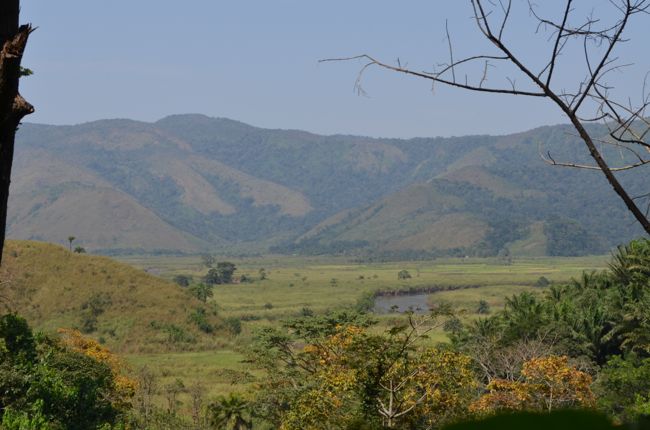
The road began to descend, briefly became paved and as we approached each corner Eric honked a warning. Often there were great holes, missing pavement, bone jarring drops and it wasn’t always possible to avoid them. But the terrain was spectacular, miles of mostly untouched tropical forest the mountains draped in shades of green punctuated with flashes of orange and red flowers. Valley and hill as far as the eyes could see without any evidence of cultivation.This is the sacred Bafut forest, protecting the watersheds and vegetal heritage of the kingdom. Unfortunately for the photographers it wasn’t possible to stop, although that narrow view seldom expresses the majesty and verdant fecundity of the scene.As the road again levelled out we crossed over the  Menchum river and  entered a broad valley.
Rice growing alluvial landscape, fields separated by ditches and flapping clothing suspended on sticks to scare away the birds. The elephant grass easily 3 metres tall where it wasn’t hacked down and piled beside the road. There were numerous highly rutted access roads down to the water where young men and boys poled their broad canoe shaped boats back and forth.

The boys dive down with buckets, scoop the sand into the boats then shovel it onto shore to be loaded later into trucks and transported to Bamenda. For a brief while we were tailed by one of the trucks, coming up behind us as we scraped our way out of one of the biggest potholes I’ve ever been in. The side of the road even with the windows of the taxi. Definitely don’t try this in the rainy season.
I attempted to take notes on this trip, writing the occasional undecipherable word as we careened and bumped along till pavement appeared again. Eric would then accelerate till the pavement gave way while I attempted to read the occasional sign naming each village.


It was quite warm in the car, the mimbo in the recycled soda bottles continuing to ferment, building up  pressure. We had the windows open but every passing vehicle would raise such clouds of dust we were rolling them up in  fruitless attempts to keep it out.
Crossing the river again we came into an area of grasslands, the rolling mountains denuded of trees except in the narrow clefts and valleys between hills.
 Then again beside the river and arrival at the falls.
  Just below the road is a small picnic area and viewing spot with a cement fence to keep folks back from the sheer drop.
 Impressive.
 A tremendous amount of water cascades down with incredible turbulence sending spray out  from top to bottom. Not much if anything would survive that fall. We stepped back and enjoyed our picnic, slowly releasing the pressure on the  warm mimbo  till we could drink it.


Then a short drive down to the crossroads at Befang; north to Wum and west to Benakuma.


By this time we’d had enough of the driving and chose to turn around.

 Stopped at the top of the falls to wet our faces and watch the boys shovel sand from boat to shore.


And again at the bailey bridge to take pictures,  then caught a few views as we climbed out of the valley  on our way towards Bafut.
 The road was not any less bumpy on the return.