Showing posts with label Cameroon. Show all posts

Saturday, 3 December 2016

Entertaining events

Dec 1
Meanwhile the entertainment, if it can be called that, continues here.
One of the volunteers went to the main market in the morning yesterday; she told us the police had appeared and locked the gates (usually happens at 5pm) to prevent the escape of some suspect. Apparently this fellow was a friend of the guy standing in the coffin last week preaching (I’ll use a euphemism) change. Eventually he was located and arrested, not necessarily in the market.
About 3 hours later we heard a lot of honking and yelling. Looking out the bathroom window (I spend quite  a lot of time checking traffic, weather and sunsets through this tiny portal) I watched a convoy(?) of motorcycles race past, many were carrying branches of greenery, hooting and hollering expressing some kind of joy or celebration. A lot of them. Many had passengers; some drivers and passengers were standing, doing acrobatics, fists in the air, mostly men but a few passengers were women.  (I have seen perhaps, 1 female taxi driver and 2 or 3 female bike drivers in the 3 years we’ve been here)  They raced down Che street towards Ntarikon. Then within half an hour they were  back and racing down Fish Pond Hill. I wish I’d had the presence of mind to take a photo… Any way it’s a one way street UP. More hooting, hollering and acrobatics down this rather steep street. They raced past the food market and turning left towards City Chemist. That’s the road I pictured with the tires burning in a previous post, the second picture of smoke and people in the street is leading towards City Chemist where the guy in the coffin spoke. It’s a round-about that turns right onto Commercial ave and SE towards Veterinary junction. Commercial runs approximately parallel to Che street out front of our building and Food market road down below us. Anyway a few minutes later, there they were again!   It was a celebration. The police had released the fellow.
Elke was scrolling through FB and saw a reference to some US Cameroonians who are requesting interventions from the US military, plus, they have collected 43 million francs for the purchase of (according to FB anyway) weapons for the struggle. You might imagine our reaction to this news. We are giving ourselves  2 weeks to pull our loose ends in, deal with our furniture and say farewell to folks we’ve met here… Unless things calm down.
Wednesday was supposed to be the end of the teachers strike, no word on the lawyers yet and nothing about any negotiations with the government. Then we heard that the teachers asked the parents of all students in English residential schools to receive them home. That will make the buses busy.
  Traffic is back to normal, noisy and backing up on the hill. Tonight the bars are full with patrons watching a football game. Everytime Cameroon scores, there is a roar of approval.
And we heard our first Christmas carol broadcast from somewhere down below.

Saturday, 26 November 2016

Instability

Nov 25
It’s back to normal here, honking taxis, the flash of reflected light down in the market, crowds of shoppers, children playing nearby and a couple of falcons wheeling and soaring above.
I spent part of the morning walking through town past the piles of charcoaled coils of wire pushed off the road, blackened pavement where the fires had been. Most of the evidence cast aside and contributing to the general debris at the side of the roads. In a few places piles of garbage mounting, smelling of course.
At the main intersections, police pick-ups, some with bored soldiers sitting in the shade under the vinyl covers, cradling their rifles. I had occasional glimpses of camouflage dressed militia here and there, walking the streets in pairs. In front of every cash machine a long line-up of people.
The vendors are busy, stores open for business, crowds around the women hawking fruit and vegetables beside the market. Young boys and older men trundling loads of firewood in their two wheeled carts.
We hear from locals that there will be a protest march on Monday. The last one here in Bamenda was “moved” to Buea so not much happened while we were gone to the farm. Some cleanup I imagine. Removing the piles of burnt tires, broken up phone kiosks and the hulk of a car off the road.
The protesters needing an outlet for their frustrations, piled tires and whatever else they could find, onto the roads across the city, setting them on fire to limit the mobility of the military.
 The response was, in my mind both pathetic and provocative. Various extensions of the military (so many  to account for and all their signs in French) racing up and down the roads randomly firing either tear gas or smoke bombs (I didn’t see anyone in tears or suffering) into the neighbourhoods, whether there were people assembled or not…! Like boys with big toys, showing off their firepower.
The helicopter surveillance (they seem to have only one) filled the air the day before we escaped with it’s noxious noise, circling the town wending it’s way across the landscape monitoring whatever.
After 50+ years of inaction and stonewalling the Anglophones are fed up. The president in power for more than 30 years appears to spend more time in luxury hotels outside the country than in. Sounds like the definition of absentee landlord living off the avails. He’s worth a fair chunk of change from funnelling monies received for the country into various offshore accounts. It helps support his playboy son heir-apparent in this fiasco. At least according to what I’ve heard.
There is talk of secession. When the British gave up their rule here, there were two Cameroons and most of the country determined that unity was the best option. That sentiment remains only on the French side now. There has been a constant erosion of rights and privileges, installations of government officials who don’t speak English and general ignoring of the desire for dialogue.
For us temporary residents, it was disturbing, anxiety raising and unpleasant; breathing in the smoke from burning tires (our  floors were covered in the dust, and this is with all windows and doors closed) random gunshots and people scattering whenever a military vehicle approached. Their laughter,  seen from my perspective, either nervous or disdainful.

 I had no desire to be stuck in civil war or any kind of violent  confrontation. That night the streets were uncharacteristically silent.
 Our driver had been unable to get past a barrier the day before so when we heard that something might happen we arranged for a quick getaway early in the morning.
Out at the farm it was quite peaceful, only a few passes overhead from the helicopter, birds singing and a beautiful star filled sky. We spent a couple of nights there, did some work on the stoves, some cultivation, chopped firewood and talked with the neighbours. Their perspective was we should not worry, nothing would come from it and everything soon back to normal, so we returned. It was ironic to be happy to hear the sounds of a busy city as we drifted off to sleep.
Monday? maybe back to the farm. And if things really get nasty? Already making plans to leave the country. But only if necessay.

Tuesday, 6 September 2016

Departing Douala


Our exodus from Douala Cameroon began with a taxi ride to another hotel. Douala is at the mouth of the Wouri river and is the major port for the country. Development has not kept up with growth and the once ample bridge built in the 1950’s is now a bottleneck. Construction on a new replacement is underway slated for completion in 2019 according to our driver. It towers over the existing structure which carries a rail line down the middle doubling as a passing lane although I doubt if much rail traffic crosses the bridge. During mornings and evenings it can take an hour or more to get across so during a lull we changed hotels.
The fellow pulling our luggage into the room said there was an early bus, that left at 8 so to get there by 6. We accordingly set our alarm and were ready to go before any breakfast (or especially coffee) was available. The driver misunderstood our request, taking us to an unfamiliar, complete war zone of a “bus station” Certainly there were structures masquerading as terminals, decrepit booths  with little roof and less seating. On top of which, at that hour, no one was selling tickets. The rain in the night had filled every pot hole and depression which along with months of garbage, refuse and discards made for a fragrant and unappetizing  prospect to walk through. The amused patrons of the stand we arrived at offered no suggestions. So we commandeered another taxi to take us to the “early bus” stand.
Arriving at the now familiar bus stand it was almost impossible to enter due to the narrow entrance and dedicated taxi drivers, motorcycles and pedestrians streaming in and out. Mayhem barely describes it. Elke alighted to go purchase tickets while our driver jockeyed with the other drivers and entrance guards. He managed to convince them to let him in to disgorge me and the luggage then quickly escaped. After dragging our bags under cover, I stood watching while the line slowly inched forward. It was a long line. Snaking from inside where patrons were seated on benches and shuffled forward as tickets were purchased back again on itself reaching around the roof supports and a pile of luggage, well past the building and onto the “sidewalk” behind.
Out in the yard taxis continued arriving  with more passengers. Trucks and buses came and went backing up slowly with liberal use of the horn as the motorcycles and pedestrians negotiated around the moving vehicles with little concern. Aplomb I believe it is.
A couple of women came up to us who had been at the previous bus “terminal” where tickets were apparently sold out. An explanation for the chaos was soon forthcoming… school start on Monday so everywhere families and children are returning. By 11 o’clock when our bus finally pulled out they had filled three and were working on the fourth.

Sunday, 20 December 2015

The Fon's dance

Once a year the Fon (King or traditional leader) of Bafut hosts an amazing cultural festival the Bafut “Abin”. We have attended now 3 times and this year I danced. Finally!
 The official invitation  includes lunch with the Fon held on a grassy meadow below a massive tree to the left of the museum. At the top of the stairs to the museum, a guard let us through the gate. Chairs were spread along the stone fence overlooking the parade grounds and parking where the dance would take place. We arrived well after the stated start time and waited patiently for his highness, and everyone else to appear.
 When the Fon appears everyone  must stand, till he is seated, and the same when he leaves, till he’s out of sight. He sat flanked by his retainers in their tie dyed indigo ceremonial cloth “skirts”, shirtless, each holding a  2 metre spear.

To his right facing us (sort of, he was behind a small tree) dignitaries are placed according to some formula. Most of them know not to arrive too early, some managing to arrive as they were called up to eat into the serving line.
We sat in the shade, under a canopy till it was our turn to be called up.  The Princesses in traditional attire walked past and an almost endless procession of robed and hatted elites, relatives and invitees arrived. Beer was the chief liquid refreshment although there were also a variety of flavoured  bottled bubbling beverages available.
We were entertained by a local photographer tour guide, who found us to be interesting subjects dressed as we were in traditional clothing. This year I intentionally left my camera behind. Last year I spent most of the event staring through the viewfinder or at the display screen, attempting to capture the pageantry, sumptuous fabrics and embroidery  swirling around me.
It was not so bad at the festival, but I’ve experiencing some challenges taking pictures. The locals never seem to have an issue but my white face brings out resistance and demands for payment.

A number of familiar faces drifted by and we greeted and were greeted ourselves by old acquaintances and friends. This is a well attended opportunity to see and be seen, an annual gathering of the tribes. Family groups, dance groups and the like wearing similar fabrics, designating that they were representing some faction of the populace.
Once lunch was done we stepped out to sit together in one of the local bars while the traditional rites took place. Outside a continuous parade of brightly coloured robes and dresses passed by in the bright sunlight. A vendor came in and I bought a(nother!) hat. I’d noticed most men had a new one each year, so…
I spotted a group going past with swords, spears and bows and arrows so we finished our beers and wandered back through the throng. The crowd was growing, the bandstand full. We positioned ourselves in front of the sacred drum and watched a group slowly make it’s way towards us from the palace, beating drums and playing flutes.
The Fon and the Mayor stood out and blasted away with shotguns,
then the first group came chanting, brandishing weapons and posturing  to stand in front of the Fon and his party. The point of it all is to show they are fierce enough to protect and support the Fondom from attack. Pledging allegiance. But this year no other guns were fired and there were fewer groups or quarters represented.
And then the Fon  began leading a group of notables in the beginning of the dance. He made a small circuit, then sat down to watch. The drummers had maintained their rhythm and moved in closer to the centre.
As the Princesses passed by in a long line  sweeping their horse hair fly wisks in time with the beat, other folks tagged on. I was grooving to the beat and it just seemed natural to step in and follow along, with my cane in hand. The woman ahead of me was impressed and guided me through as we circled in a long oval past the spectators ringing the procession. Numerous cameras and cellphones caught me as I slowly shuffled along. As we approached the shrine she told me to face it as we danced past.
 As I passed the royal party, first the mayor and then the Fon , along with a number of dignitaries,  acknowledged me with raised fists or canes. I was able to respond in kind by lifting my cane.

After 3 or 4 passes both my guide and I were done and  we melted back into the crowd. As best I could anyway, being one of about 9 white faces in a sea of Bafut Cameroonians.
An incredible spectacle, I felt like a Bafut man dancing with the people.

Friday, 4 December 2015

Integrity, culture and service

Not so long ago I returned to Vancouver Island and North American culture from an extended time in Europe and Africa. My partner and I moved onto the land at OUR Ecovillage  to contribute our experience and wisdom into the mix of people there who have come to learn and grow.  It was a bitter sweet reconciliation for me. Back among both new and familiar friends, family and flora I was eager to apply what knowledge I had of land stewardship and husbandry to assist in the creation of new ways of being. After being away it was refreshing to know the trees, see connections and recognize an ecosystem’s elements. It was exciting to fit in so well, sharing accumulated knowledge with open and receptive minds.
After some time I became discouraged. Not because of who or what is possible or imagined at the ecovillage but by the forces that would prevent or discourage those changes, those possibilities. I  saw through a different lens the incredible amount of energy, resources, time and mental space necessary to live in North American culture. The racism, sexism, ageism and blatant disregard by those with all the money or power, was if not in the best sense of the word enlightening, incredibly disgusting and stressful to me.
 In order for this society to exist as it is, millions, billions of people live in abject mind numbing poverty. Every time I got in the truck to drive somewhere, out on an errand or for some recreational activity it came to me. How easy it was to justify. Except I don’t recall previously needing to justify it. Like virginity, once the experience has happened there is no return. I have knowledge and experience that affects my perspective forevermore.
 I had conversations with myself about my personal integrity. Reflecting on the folks in Cameroon whose income could be measured in pennies to our dollars.
At one point I saw a souped up 30’s roadster painted bright orange cruising down the highway. What I make up, is that some (likely male) individual has a hobby restoring these things, then drives around  to show it off or whatever. They have privilege, partly due to hard work creating income and a comfortable life, but also thanks to a system set up to encourage promote and sustain growth and consumerism. For the rest of the world who all seem to want this “success" unaware of the consequences, there is a massive disparity of value. I see it tied to the incredible complexity of modern societies. Something, someone has to pay for this. The levels of bureaucracy,  the myriad relationships to manifest all those “affordable" consumer goods,  the employment opportunities,  the communication networks and the endless disposable “toys”.
 My time in Cameroon and Tanzania opened my eyes.  We are all under the influence of the corporautocracy. I call it corp-hypocrisy.  I don’t like the direction things are going politically in North America.  It seems out of control and everyone (for the most part) is like the frog in the frying pan, the heat slowly rising.
 From a distance and on social media many are saying it has to change, the end is near, read this etc. Having an opinion is great but posting isn’t enough. I need to put my words and actions in alignment and motion by living what I believe, being the change.
I get that flying in airplanes contributes to climate change, after all, everything is related.  I’m willing to make that compromise in order to do  service in Bafut Cameroon, where I feel more in alignment with living from a permaculture perspective; contributing my wisdom and experience while being challenged and learning from the environment and people there.
 Maybe I’m delusional. But the shadow of that is that I believe most North Americans ARE  delusional, thinking their rate of consumption is sustainable or has no impact. And the reality is that the small things we do pale in comparison to the mega projects creating mass pollution from the petro chemical  plastics industries, throwaway cellphones and non-stop production of new vehicles to name just a few.
 There are 7 billion people and counting on the planet. In various places in the world due to an inherent desire for more, people are dying in civil wars, they are exploited, enslaved and abused, used up and thrown on the trash heaps of our societies. I don’t feel comfortable or in integrity with that cultural construct.
Living in harmony and balance is ultimately the goal, at least for me. Sharing the surplus, taking care of each other and  creating no waste are all part of this. Applying and living with these ethics goes a long way towards an equitable existence. My observation skills improve in application; everything is related, every function in every ecosystem supports the whole, supporting the planet. Working WITH is easier than altering existing systems. Patience pays off in allowing the systems to express themselves. The diversity of the edge is where things are really transformative and greater possibilities exist. I  can apply this understanding in all earth based experiences and possibly mechanistic and technical situations. I can change the world, along with supportive community where ever I find it.

Tuesday, 1 December 2015

Field trip on the Ring Road-Menchum Falls- Bafut to Befang and back

After some time the city, meetings, research and visits to the farm aren’t enough. We want to see some of this country so called a friendly taxi driver to take us on a tour.
 First stop the Bafut market to pick up a few snacks. Then to a nearby bar for some white mimbo or palm wine followed by a stop at a spring for some fresh water.
The road out of Bafut is dusty, clouds of it settling on the bananas turning their leaves red, Potholed and rough in places we swayed back and forth as Eric the driver negotiated each stretch and avoided oncoming trucks and minivans. The road twists and turns into valleys, around mountains,  past villages and farms. These smallholdings with minimalist rectangular redbrick buildings, unplastered and roofed with corrugated “zinc”line the road between sections of forest and  field. Often there were children and occasional adults staring as we drove past.  Upon spotting our faces the children would chant “whiteman, whiteman” to which I, as often as possible, waved in reply.
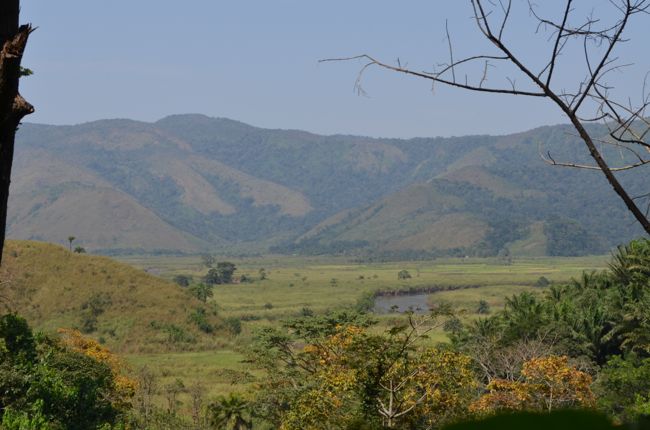
The road began to descend, briefly became paved and as we approached each corner Eric honked a warning. Often there were great holes, missing pavement, bone jarring drops and it wasn’t always possible to avoid them. But the terrain was spectacular, miles of mostly untouched tropical forest the mountains draped in shades of green punctuated with flashes of orange and red flowers. Valley and hill as far as the eyes could see without any evidence of cultivation.This is the sacred Bafut forest, protecting the watersheds and vegetal heritage of the kingdom. Unfortunately for the photographers it wasn’t possible to stop, although that narrow view seldom expresses the majesty and verdant fecundity of the scene.As the road again levelled out we crossed over the  Menchum river and  entered a broad valley.
Rice growing alluvial landscape, fields separated by ditches and flapping clothing suspended on sticks to scare away the birds. The elephant grass easily 3 metres tall where it wasn’t hacked down and piled beside the road. There were numerous highly rutted access roads down to the water where young men and boys poled their broad canoe shaped boats back and forth.

The boys dive down with buckets, scoop the sand into the boats then shovel it onto shore to be loaded later into trucks and transported to Bamenda. For a brief while we were tailed by one of the trucks, coming up behind us as we scraped our way out of one of the biggest potholes I’ve ever been in. The side of the road even with the windows of the taxi. Definitely don’t try this in the rainy season.
I attempted to take notes on this trip, writing the occasional undecipherable word as we careened and bumped along till pavement appeared again. Eric would then accelerate till the pavement gave way while I attempted to read the occasional sign naming each village.


It was quite warm in the car, the mimbo in the recycled soda bottles continuing to ferment, building up  pressure. We had the windows open but every passing vehicle would raise such clouds of dust we were rolling them up in  fruitless attempts to keep it out.
Crossing the river again we came into an area of grasslands, the rolling mountains denuded of trees except in the narrow clefts and valleys between hills.
 Then again beside the river and arrival at the falls.
  Just below the road is a small picnic area and viewing spot with a cement fence to keep folks back from the sheer drop.
 Impressive.
 A tremendous amount of water cascades down with incredible turbulence sending spray out  from top to bottom. Not much if anything would survive that fall. We stepped back and enjoyed our picnic, slowly releasing the pressure on the  warm mimbo  till we could drink it.


Then a short drive down to the crossroads at Befang; north to Wum and west to Benakuma.


By this time we’d had enough of the driving and chose to turn around.

 Stopped at the top of the falls to wet our faces and watch the boys shovel sand from boat to shore.


And again at the bailey bridge to take pictures,  then caught a few views as we climbed out of the valley  on our way towards Bafut.
 The road was not any less bumpy on the return.

Wednesday, 9 April 2014

Homemade micro Hydro

While in Cameroon an opportunity came up to visit the site of a small hydro project in Kugwe near Batibo (the Palm Wine capitol of the world!).
Local engineer  Farmer Tantoh arranged the trip and we wedged ourselves into a crew cab. Elke and I sitting up front, Joram and Tantoh conversing behind us non stop.  Our driver, Divine, quietly   answered our questions; (mostly Elke's) names of towns, items for sale at the side of the road with a little about himself while enjoying his music as we passed through the inevitable checkpoints.
 The road was good, paved within the last 3 years, through rolling hills mostly deforested and covered with grass.  Occasionally we'd dip into a jungle like valley but the majority of terrain around the settlements and villages was small farms. At numerous junctions there would be clusters of motorcycles,  large plastic containers hanging off the back, stacked sideways; 20+litres each, blue and white, empty or filled with mimbo (palm wine) for sale elsewhere, the drivers waiting...

Turning off the pavement we spied a fellow climbing a palm beside the road, his palm stem belt allowing hands free action when trimming the fronds.
The road  began to deteriorate, narrow, more potholed and still we drove on turning eventually down a trail, wheels straddling the twists, turns and contours. Parking amongst a group of houses,  people emerge with great smiles on their faces extending hands to shake and even a few hugs. Adult men mostly, children shyly looking through doorways holding back.
After a few moments of greeting we are immediately underway walking along the path following a line of wire strung up on poles through trees past extensive gardens, swales running down hill, burnt over and in various stages of cultivation. The air is thick with moisture, it's warm and I'm immediately sweating.


The trail descends, crossing a stream, swampy and fetid with decomposing vegetation the air filled with the spicy smell of something blooming.


 It gets steeper, slippery and the men attempt to help me, to stop me from falling as I grasp this or that root, vine or branch.


 We  hear the waterfall and  then stand at the top where they have engineered a sluice-way to pipe the water to the turbine another 50 metres below.
No water runs now, the pipe is punctured. Unfortunately, rocks hurtling down inside have broken the plastic. But for 5 days they did have light in the village.


What effort it  must have taken to haul the pieces and parts down this steep and treacherous slope!


 We continue, handholds necessary as I negotiate the nearly vertical climb and descend onto another small outcropping.


Here they have installed their turbine using a used auto transmission and various mechanical and electrical components.
   It sits now waiting to be reengaged. Ingenious, resourceful and creative, these folks are still positive, hopeful and encouraging.
 Elke and Joram film and interview them standing proudly behind their creation, the waterfall roaring in the background.


Everyone then inches out onto the slippery rocks, another 70 or 100 metres above the last drop and we all pose for "snaps".


On the way back up my shoes seem to fall apart (velcro doesn't like mud), I'm exhausted, recalling in my youth bushwacking through the Devils Club and Salal above Sombrio on West Coast Vancouver Island. Thankfully I've seen nothing here like Devils Club, grabbing whatever I can to haul myself up. Reflecting on my age, I compare myself to these   30-40 year old "young" men who almost daily make their way through this landscape.

 Back at the village I learn that the women, missing from the meal, speeches and mimbo drinking session we enjoy later, are off working their farm/garden plots a 3 hour walk away...


They have big dreams here; to improve their children's chances of success by providing  light so they can study at night,  by creating fish ponds to supplement their diet,  building cabins for visitors to stay and of course to get their electrical system working again as model of what can be done with a little ingenuity and resources at hand.


This experience like many others, inspires me in my exploring, meeting people and assisting where possible as we continue to create a better world for all.

Friday, 28 March 2014

Bookstores


I love bookstores. Wandering the aisles, searching out my favourite classifications to see what the latest author has to offer, browsing the pages of some beautiful coffee table extravaganza. Almost as entertaining and satisfying as visiting a library where I can take those books home! At least briefly.
But here in Bamenda Cameroon, I've had to readjust my assumptions and expectations.
 My experience of bookstores has taken a giant leap... sideways. It's not that there are not bookstores, there are.
Along Commercial Avenue I spotted the Simplicity bookshop, Academic bookstore and College bookstore to name just a few. I had some specific interests I wanted to explore; some technical tomes on indigenous flora, maybe a few local authors  for their perspectives, something about Cameroon itself, local geography, history....

Cue in the sound of the NOT buzzer from some game show.


First of all most of those "bookstores" have a large counter just inside the entrance preventing entry. The few books available are shelved out of reach behind the counter and are either religious or elementary to secondary school texts. And there are precious few of them.


They do have stationary, pens and paper, but are just as likely to be selling; clothing, cookies, onions, appliances or miscellaneous hardware.

As for any technical books... after a long search into every bookstore I saw, we found in one, a few copies of a moth or silverfish eaten agricultural text that seemed too outdated to be useful. Nothing else.

 Across the boulevard are the street vendors, their carts piled high with used and new school texts, photo albums, daily calendars, diaries and scrapbooks.

Browsing here is very different. Each of those used and  sometimes ratty looking paperbacks  represents more forcefully the bottom line for these guys. I'd pick one out and there would be the vendor already to wrap it up and offer me another.

 With patience and some tips from more experienced buyers, I was able to negotiate a better price and find some of what I was searching for. Used of course.

One day I visited one of the local Universities with another volunteer.  Her research had led her to search the stacks in the library there, where we found a text book recently written and published locally by one of the professors at that same  University. Is this book for sale somewhere?
Unfortunately he had passed away, so we asked the fellow there to contact his wife as we wanted to purchase ....
Cue in the buzzer.


Other than those street vendors, and this one in particular, I 'm convinced there is a culture of non engagement with literature here, no one can answer my questions about specific books almost no one even seems to know what I'm talking about!
Case in point , the local "library" The custodians of the books , the librarians, don't seem to know what they have, the card file is not accessible, the books I saw were all donations, out of date, used and abused. They did have a large collection of fashion and political magazines from France...
I won't give up though, I've heard there is a bookstore in Yaounde...

Friday, 13 December 2013

December 13  2013
I'm sitting here in Bamenda on a cool a grey morning looking out over the town below. The market as usual is busy with taxi's and motorcycles dropping off and picking up people loaded down with packages of things to sell or what they've purchased. From up here it's like watching an anthill peppered with tiny umbrellas, an occasional bus slowly working its way along the edge. Directly below us are houses, compounds mostly made of mud brick covered over with corrugated tin roofs. You can imagine what it sounds like when it rains. These buildings descend like steps, intermingled with bananas, papaya and mango trees down to the market. The sounds of people talking, yelling, banging away on metal, an occasional dog barking, children crying, laughing and playing mingled with loudly broadcast music and the ubiquitous honking goes on into the night daily.
Beyond the market the terrain rises slightly covered with concrete block buildings,  some apartments, but mostly business's. We walk that way frequently going downtown. One whole section is dedicated to car repair, parts and "service" the rusting hulks of cannibalized taxi's, vans and small trucks willy nilly lining the "roads". When it's been raining it is barely navigable on foot, rutted and potholed it turns into a quagmire with all the metal, broken glass and spilled oil unevenly distributed for blocks. The paved street two roads over to the right is like a racetrack, the taxis and motorcycles weaving up and down as the pedestrians squeeze between the parked cars and the live traffic, a constant stream of humanity walking back and forth with goods for sale on their heads, or delivering used car parts, business men in suits and women with babies.
 Not many tourists here, it's almost worth remarking when we see one. Ironically they seldom acknowledge me, some kind of denial that there could be anyone else having this unique experience, I know I've felt it myself, and read about others experiencing and describing it... Read any Pico Iyer? He nails a lot of the traveler's angst and dismay.
Beyond that commercial area up to the left a ridge with more apartment buildings rising up it's slopes and some open land at the top, likely a religious school or church grounds. Almost every educational facility here has Presbyterian or Catholic affiliations. And they seem to own most of the green space, beyond the individual garden plot everyone has to grow their sweet potato, corn or assorted yam varieties.


Behind all that there is more, and more of the same to the north and west but it's framed by cliffs that line the south east edge, houses and compounds climbing to the vertical limits.  We climbed up those slopes a few weeks ago to view one of the waterfalls.


I find it incredible how people can manage to capitalize on the slightest amount of barely level ground and punch in a garden. Although the gardens themselves are not visible from here, I recently saw fires and smoke so assume they are doing slash and burn as we approach the dry season.
Up top in Upstation, the government officials, high rollers and gentry of the place have massive properties with even more massive "houses" among the very old mansions built during and since the Germans were here 100 years ago. Apparently the view up there is spectacular. It was hard to see through all the hedges, walls and fences erected around their properties.
The view from here is pretty amazing, the mountains beyond blocking the sun's rise until 6:45, later lit up as it sets. It's a constantly changing panorama when the smog/mist clears.

I've been reading an old travel guide; this place has tripled in size in ten years; you can well imagine the infrastructure  challenges. The folks next door down below have an outside shower and biffy and put out buckets to collect their water or walk a few blocks to a seemingly public "tap" which I first thought was a leaking waterline. It may be, but recently some enterprising individual poured concrete around the outlet and installed a pipe. Everyday there are kids surrounding it waiting with their used plastic "jerry cans" to fill up and haul off.
The dry time is coming, when the Harmattan blows sand and dust off the Sahara, blocking the sun for days at a time and dropping the temperature.
Not enough for a white Christmas though.