I have been and will continue to be, an educator. But, something else is happening to me. I have set in motion a retirement, new vistas and new possibilities for my own learning.
When I pay attention there are opportunities for promotion and notoriety. Or is that recognition and fame? Woah that brings up the shadow!
Apparently today one must brand and market to establish a presence that attracts a following in order to survive. As a writer. Did I ever consider myself as such?
Yes I have aspired to this dream. Being a writer. The rest of it seems like such triviality and hubris. I look at the sites of some writers. Paulo Coelho says he spends 3 hours a day on social networking and his blog.
I have that kind of discipline. I am making that commitment.
My life at the moment is in transition. I feel like a neophyte, in chrysalis, about to emerge in another place, another time, another incarnation of myself.
What I want is to share those sparks of recognition, of identification and possibly, enlightenment. To make you laugh, share intimate moments of embarrassment and pleasure. See the world through my eyes.
That caterpillar reaching out to investigate my camera lens is a great metaphor. The vast horizon stretches out before me in all directions.
First a summer spent enjoying the Cowichan Valley while I determine what to keep and what to discard or give away. Then a fund raising bazaar (Bizarre?) garage sale fund raiser for the folks in Tanzania. Money is lighter than bicycles and sewing machines which we can buy there. Spiced with many visits to friends and acquaintances, face to face remembrances to cherish and recall as we go our separate ways.
And as for making a living writing... what comes from traveling? New roads, horizons, acquaintances, friendships and experience. That will define me.
Monday, 4 July 2011


Tuesday, 1 February 2011
Life at the Shamba
It did take awhile to settle into a routine, sleeping on a thermarest (thanks Matthew!) in Elke's tent. At bedtime we would lift off the fly (until it rained) for more air and open the screen doors briefly if it was windy. The night air was warm, not cool so the less movement the better. Morning light would bring me awake around 5:30 I'd get up and bring the water to boil. Small dry little limes not lemons for me and coffee for Elke with fresh cows milk provided by the Maasai boys. Maybe a bit of fruit or muesli and the day began while it was not hot. Some mornings I would have a shower with the bucket, the closest we ever came to cold water.
The day might bring plumbing fundis, carpenters or masons. And of course the brick makers. As the bricks accumulated for the firing, one morning a massive thunderstorm approached. All of us, kids included, ran into the field to pile the bricks. Passing them in chains to pile up and be covered with tarps, tent flys, plastic bubble wrap and banana leaves, anything to hold back the rain and getting completely soaked when it arrived.
I helped collect and sort tiles for the mosaics, hauled sand and clay for plaster, carried bricks, wood and compost. Spent time plastering, setting tiles, stretching tarps for shade, and the ever present need (in my mind anyway) of harassing the chickens from next door who assumed that the gardens, compost and outside kitchen area were their turf. A motley collection of hens and roosters who came in waves and were easily frightened by long pieces of plastic pipe waved menacingly in the air then hurled spear-like in their general direction. No one else except Elke seemed as concerned by the mess they made, the garden seeds they ate or the biomass/protein they consumed and converted into eggs which I'm sure the neighbours enjoyed. Occasional jokes were made about popping a rooster or two into a stew pot, but it never happened.
Food was a bit different from what I usually eat, the occasional goat they butchered would be sent off to town to be grilled, stewed or barbecued for the patrons of the Policemen's mess. At lunch with the workers us volunteers got to eat the tripe, in tomato sauce, some greens usually amaranthus retroflexus (that would be pigweed or redroot) in tomato sauce, small fish in tomato sauce and always, well mostly, Ugali. At night there might be rice or noodles and tomato sauce with greens, fish or, you guessed it tripe. Although, once in awhile Caito would cook delicious meals with beef or goat or a larger fish, once even burgers.Yum! Generally the food was good, satisfying, filling and tasty.
Ugali though was a challenge for my western palate. Just before the lunch would be served, a large pot of water would be brought to the boil. A yard long spoon begins stirring as a white powder is poured rapidly into the water, stirring and moving the congealed mass like rubbery mashed potatoes so it doesn't burn. It then gets turned out into a washtub and served using a plate as a scoop in large, shall we say HUGE chunks onto the plate. A piece is torn off rolled around in the right hand and then dipped into the side dishes. The white powder? Corn starch.
After lunch in the heat of the day I spent quite a bit of time resting, reading in the shade of the front porch and jumping up to chase chickens. It got so when I stood up, raised my arms they would turn and run away. Although to be honest one hen with 4 chicks would mostly proceed forward with increased vigor ducking into the nearest banana plant or scooting under the thorny fence. Eventually the dog got into it, half heartedly for sure, it was after all, hot!
Later as the sun lowered itself westward the temperature dropped somewhat and we might continue working, setting up the transit and mapping out the site checking elevation and distance between buildings and citrus trees. Occasionally a trip to town for beer, Stoney Tangawizi or access to internet. Often in the evenings the generator would be fired up, lights on in the house and to charge the batteries of cell phones and computers, so Elke could work on house plans while I was reading in the afternoons. And I read! From Terri's collection: Three Cups of Tea, Tears of the Desert, Baking Cakes in Kigali, Unbowed, Nisa: The Life and Words of a !Kung Woman and The Man Who Tried to Save The World.
After dinner at 8 we would wander back around the house, lie back in the wicker chairs and look at the stars or the lightening off in the distance, listening to the drumming and singing across the valley. It might go all night, at least it was going when I woke up some mornings.
The day might bring plumbing fundis, carpenters or masons. And of course the brick makers. As the bricks accumulated for the firing, one morning a massive thunderstorm approached. All of us, kids included, ran into the field to pile the bricks. Passing them in chains to pile up and be covered with tarps, tent flys, plastic bubble wrap and banana leaves, anything to hold back the rain and getting completely soaked when it arrived.
I helped collect and sort tiles for the mosaics, hauled sand and clay for plaster, carried bricks, wood and compost. Spent time plastering, setting tiles, stretching tarps for shade, and the ever present need (in my mind anyway) of harassing the chickens from next door who assumed that the gardens, compost and outside kitchen area were their turf. A motley collection of hens and roosters who came in waves and were easily frightened by long pieces of plastic pipe waved menacingly in the air then hurled spear-like in their general direction. No one else except Elke seemed as concerned by the mess they made, the garden seeds they ate or the biomass/protein they consumed and converted into eggs which I'm sure the neighbours enjoyed. Occasional jokes were made about popping a rooster or two into a stew pot, but it never happened.
Food was a bit different from what I usually eat, the occasional goat they butchered would be sent off to town to be grilled, stewed or barbecued for the patrons of the Policemen's mess. At lunch with the workers us volunteers got to eat the tripe, in tomato sauce, some greens usually amaranthus retroflexus (that would be pigweed or redroot) in tomato sauce, small fish in tomato sauce and always, well mostly, Ugali. At night there might be rice or noodles and tomato sauce with greens, fish or, you guessed it tripe. Although, once in awhile Caito would cook delicious meals with beef or goat or a larger fish, once even burgers.Yum! Generally the food was good, satisfying, filling and tasty.
Ugali though was a challenge for my western palate. Just before the lunch would be served, a large pot of water would be brought to the boil. A yard long spoon begins stirring as a white powder is poured rapidly into the water, stirring and moving the congealed mass like rubbery mashed potatoes so it doesn't burn. It then gets turned out into a washtub and served using a plate as a scoop in large, shall we say HUGE chunks onto the plate. A piece is torn off rolled around in the right hand and then dipped into the side dishes. The white powder? Corn starch.
After lunch in the heat of the day I spent quite a bit of time resting, reading in the shade of the front porch and jumping up to chase chickens. It got so when I stood up, raised my arms they would turn and run away. Although to be honest one hen with 4 chicks would mostly proceed forward with increased vigor ducking into the nearest banana plant or scooting under the thorny fence. Eventually the dog got into it, half heartedly for sure, it was after all, hot!
Later as the sun lowered itself westward the temperature dropped somewhat and we might continue working, setting up the transit and mapping out the site checking elevation and distance between buildings and citrus trees. Occasionally a trip to town for beer, Stoney Tangawizi or access to internet. Often in the evenings the generator would be fired up, lights on in the house and to charge the batteries of cell phones and computers, so Elke could work on house plans while I was reading in the afternoons. And I read! From Terri's collection: Three Cups of Tea, Tears of the Desert, Baking Cakes in Kigali, Unbowed, Nisa: The Life and Words of a !Kung Woman and The Man Who Tried to Save The World.
After dinner at 8 we would wander back around the house, lie back in the wicker chairs and look at the stars or the lightening off in the distance, listening to the drumming and singing across the valley. It might go all night, at least it was going when I woke up some mornings.
Thursday, 6 January 2011
First days;Bagamayo and the shamba (farm)


The dalla dalla was a mite tight. At first we were sitting on the left side together then Elke noted that would be the side the sun shone on. I moved and sat beside a woman. Then the woman in front of us sat where we had been so Elke and moved into that seat. then the woman moved to sit beside the woman I had sat beside. Rules/customs around men touching women. I swear I didn't touch her!
So onward towards Bagamayo stopping , well barely, with the fellow at the door calling “Bagagmayo” then we speed off. Arrival at the bus station. Elke tells me it is new, been here only a year, lots of taxis buses, bajajis and piki pikis. She knows a good spot to get a beer, the Florida Inn. We sit upstairs overlooking the street, eat chips mayai and drink a Savannah (apple cider from SA) I am in culture shock I think. Isn't this supposed to be a town? It seems more like endless small apartments at the side of numerous roads, I am finding it hard to get my head around this, There are lots of people, few in uniform but no one seems overly threatening or amazed to see me. Well some of the kids and the older men are sure staring, but if I smile or lift my eyebrows or say “Mambo” I get a smile back and “pao”
Elke is eager to get back to the Baobab Shamba so we hail a bajaji and hurtle past numerous storefronts selling almost everything one might need as well as little displays of mangoes and pineapple, tomatoes, potatoes, cassava and bananas. The traffic coming to town seems to consist mostly of bicycles loaded down with piles of 3 foot sticks and huge bags of charcoal 4 or 5 to a load. They aren't riding as much as pushing them along.
The road into the shamba is rather rough , sand, ruts and huge bumps winding its way through the cattle corrals, mango trees and cashews. There are few people here. Elke wasn't expected for another couple of days so we set up our tent and say hello to Gabriel and Kenneth then wander around looking at all that has been built and where it all rests.
Over the next few days I begin adjusting to the heat. The other volunteers show up on piki pikis each morning, the crew making bricks starts work at 7 and toils away with a few breaks till 5 or 6. In the hot sun. I do not know how they do it. I walk around with sweat dripping off my nose barely moving and these guys are chopping into the clay bank with their hoes which are offset, the blade about a foot long, mounted like a pick with 5 foot handle.

Then add water and sand squish it up with their feet and load it into the forms, carried over to the drying area, flipped and slipped out. These bricks will be fired sometime soon. After about day three we had an enormous rainstorm in the night and a lot of the bricks don't look so good now.......
There are also some other men, fundis is what all these guys are called, mixing sifted sand, cement and water then pushing the resifted and mixed mix into a brick press. They show up about every other day and work all day long punching out these bricks, laying them gently in rows to set in the sun.

We have come into Bagamayo a few times now; spent the night at Francesco's Christmas eve, had dinner with Amy, Kirsten and Christina at the Millennium , walked the beach, swam in the Indian Ocean, it is so warm!
I commissioned some earrings in ebony, came to town on market day...OMG! The number of people, the quantity of goods... I so wanted to take pictures, but, not recommended!
Bought some fabric, a wok(for the shamba) and a few carved bowls. I have been restraining my spending impulses but enjoying the different beers. They quench the thirst like nothing else, except maybe “Stoney Tangawizi” the local Ginger Beer.

Wednesday, 5 January 2011
Arusha to Dar Es Salaam
It was our time to go, Sean was flying out to Nairobi to meet his girlfriend and go safari, Seppo off to Finland for Christmas and we were scheduled (or so we thought) for arrival in Bagamayo in 36 hours. Juliet had arranged our bus tickets to Dar and when Seppo dropped us off it looked like we might take the early bus. No go, our tickets said 9 and that’s what bus we were getting. Unfortunately our seats were between windows, fortunately the bus had air conditioning and the temperature was now 31C. Unfortunately the air conditioning broke down. At one point it was, according to the on bus info display, 42C. We stopped twice in the middle of ..somewhere so folks could go pee and a couple times before Moshi to pick up passengers. At most stops including the weigh station locals held up offerings to the windows. In the 11 hours we sat on that bus we got off once for a 15 minute lunch break, fried/roast chicken and chips. Elke bought some plums and the bus lady dispensed soda pop and water. At one point the bus slowed and at the side of the road were a number of people. Down below, the earlier bus to Dar upside down with a tarp draped ominously over the front windows. Yikes! We also saw a bus face planted into a building and tanker truck laying on it's side in the ditch. We drove through heat and torrential downpours, fields of sisal, palms, bananas and African scrub, and almost everywhere there were people walking along the road. By the time we got to Dar our taxi driver William had called concerned we were in that bus that had flipped. It was now dark, the traffic made it almost impossible for the bus driver to pass anyone and we had slowed right down. With the windows open we could smell the many odours and scents wafting through from the settlements towns and bus stops we were driving through. Folks were getting off now, a feeling of anticipation in the air as Elke warned me Dar's bus station was chaotic and good place to get pickpocketed. I stood my ground when assailed by taxi offers, especially since Elke told them we already had a driver. We hauled out our stuff from under the bus, the two packs and the big basket with the incredibly fragile cargo (really? You won't believe what this pot has been through already!)
William brought the car around, while I stood guard, then drove us to our hotel. The power was out, we were unable to get any food, but beer was available. Our dinner of dutch cheese and crackers was wonderful as we watched the lightening crash around us and from the balcony stayed dry as the rain came down in buckets, drowning out the sound of the generator, next door. Have I indicated how hot it is here? We went to bed and lay as still as possible under the mosquito net. When the power came on later, turned on the fan and had a fairly good sleep.
Continental breakfast has to be an oxymoron or something, sheesh. Lucky for me there was fresh mango and papaya. It was Elke's birthday so something special need happen!. Walked along the road in a couple directions looking for beach access, finally finding it, already hot, we sat in the shade in front of a big resort /bar watching fishermen pulling in their nets and big dugouts being poled around as the tide dropped. Too early for beer we stopped at a bakery then after arranging to leave our stuff at the front desk, hailed a bajaji (3 wheeled taxi) and cruised on over to the Slipway.
All along the sides of the roads here and in Arusha there is nursery stock. Hundreds of pots of landscaping trees, fruit trees, shrubs and perennials. I am enthralled with the variety. If only I knew what half of them were! I want to buy some for the shamba!
Traffic here is crazy, but our vehicle is able to drive along the shoulder, whip into openings and avoid the standstill. Some of the roads are less than smooth, shall we say, once we get off the main tracks. Through neighbourhoods with walled compounds, the broken glass along the top only slightly less friendly than the barbed and electrified wires protecting some special people from something. We all have our ways of creating safety.
At the Slipway I see more white people in one hour than I have in the week I have been here. Off to the left looking North is the bay and many dhows, yachts and dugouts are anchored or beached on the sand. The tide is out and there are orange and blue crabs scuttling around below the walkway. I have promised Elke to take as many pictures of her as she has years today. Funny how difficult a task that can be... We meet her friend/volunteer Sally, have a drink, some lunch and tell stories. She has some suggestions for Zanzibar.
I am enthralled with the basket weaving, the beadwork and fabrics but we are both a little overwhelmed as we rush through the market hardly seeing anything. The basket weaving at one stall though has my attention. The sellers are insistent until we tell them we will be back. We need to measure the pot, although I am thinking of getting two baskets, they might nest together for later at home!
Another bajaji back to the hotel. William arrives, we load our luggage in his trunk. He will meet Caito and transfer it into his car as Caito has room for luggage not passengers. We take the dalla dalla to Bagamayo.
Kiliminjaro Airport to Arusha, late at night careening along in Seppo's Land Rover. The mountains a faint outline to the north, right hand drive, folks walking along the road. Seppo points out Mount Kiliminjaro, a faint smudge in the dark. Climbing out of one gully we swerved around an unlit tanker truck crawling up the hill, later a dalla dalla being pushed through some settlement in the oncoming lane no lights there either. And then, a room, a bed and I'm asleep.
Morning. I want to go outside to photograph the trees in the early light, but the door is padlocked... I hear Roni and join him watching cartoons from South Africa and who knows where else. Seppo takes me downtown, we spend the better part of the day gathering materials and arranging. Three bicycles, a sewing machine, food and unfortunately no roofing material. The trailer is too small for the 140 units of folded woven palm thatch.
I'm amazed by the burdens folks are hauling around. How ironic I think as I contemplate my own.
While I'm waiting for Seppo and Costa the builder to return with the bicycles the parking lady asks me to buy her lunch, flirting and engaging me in as much conversation as she has in English. I try my limited Swahili, making myself understood is challenging, the phrase book just doesn't cut it. All around me Masai men in their “blanket/shawl/robes are walking by individually and in groups talking on cell phones. On their feet everything from tire sandals to oxfords with socks. A fellow at the store/cafe across from me has a small hammer and is banging away at stuff onto a large rock while his friends/clients/cronies, look on.
The road is paved for the first 2 hours. “Lonely” looking Masai standing watching their animals, cattle mostly and goats with an occasional donkey. Sometimes small children are standing sentinel. I wave and most wave back. All across the horizon I see their round mud homes in compounds, some deteriorating rapidly although it is hard to say....... some have bundles of grass likely for thatching the roofs resting upright like stooks of hay.
Seppo points out some bee hives logs suspended from the bigger trees. I see baskets, mats, round and square hanging from trees at the side of the road when the pavement peters out in to a construction zone. We crisscross the immanent highway dodging trucks, potholes and splashing through enormous silty washes from the recent rain. Then suddenly there is pavement again. At Babita we get bites and beer with some fertilizer thrown in the back as requested by someone in the village. Now the road is no longer paved, red, dusty, narrow and rough. We pass through farms, small settlements and mostly foot traffic, bananas and maize in the fields, mangoes and sugar cane for sale beside the road in little piles.
Up and over a small mountain where isolated cyclists pass men standing by the road watching goats or mostly us roaring past till we turn left at Kolo and spy the camp on the ridge below.
Elke is glad to see us! There is chicken in the cob oven and some sisters waiting, to checkout her husband.
The watchman arrives, husband and brother-in-law to these sisters who walk back down the hill to the village of Kondoya. He wanders off to listen to the radio and we sit by the fire drinking beer and making jokes about Canadian campfires.
Elke has the executive suite, a wall tent, twin beds pushed together. In the morning I fail to get up for the magnificent sunrise over the Masai plain,
After coffee and a little breakfast we head down with trailer in tow, unload bicycles, sewing machine fertilizer and tools. The women are very happy to see Elke's husband and do a welcoming dance which Elke joins in on. Then it is time to work and mix plaster for the store they have built. Old men come up to me and begin speaking Swahili, suddenly I am at a loss for words.......all around mostly men and children are staring at me (should I be taking this personally?) I get up on the scaffolding with a tarp to make shade so it dries slowly.
I experience Ugali for the first time, remembering to only eat with my right hand. Attempt to help putting sewing machine and bicycles back together. I sit with the women as they prepare the food on three rock fires whilst speaking to someone on their cell phones. They are all dressed in bright fabrics, swathed in layers of colour. Quite a visual feast. I am introduced to some formidable matriarchs. And I begin to take pictures as Elke creates a sign with two colours of plaster, I wordlessly ask if it might be ok... and am presented with poses, hamming up children when I show them the pictures on the screen. They want more, and an almost endless stream of family portraits and individual head shots begins.
We are only there for two days, obviously I have to come back, I don't get to see the rock art or the now dry river, the incredible rain, the amazing sunsets and the growth after the rain. I did get to see a monkey at the side of the road, a very large tortoise a strange unidentified bird and numerous lizards.
When it is time to leave the women all sit together in the shade and Elke expresses appreciation, asking what it was they have come away with. The women are very grateful and empowered and tells us so, insisting we return, wanting to know when.
Later we deliver the school supplies to one of the teachers, he gives us a short tour of the school buildings, no glass, just bars like most buildings here. We take some of the mandatory pictures to record the event. Empty rooms with benches to sit on and benches to work at, some government issue posters on the doors warning against aids. They did have a small garden area in the courtyard between buildings that was swaled to slow down the water, the soil is very sandy.
It is quite something (for me anyway) to see Mangoes and Papayas growing everywhere. As we left camp the next morning after packing everything away we drove a different route through even smaller villages along an even rougher track where the inhabitants were frequently cutting down the trees for whatever reasons. It was unfortunate to my mind, limiting their shade, reducing the ground water and opening up the land to greater erosion. It seemed like a step back in time as we cruised bumping and pitching past men in their jeballahs, children and mothers staring with undisguised wonder.
Seppo was watching for a road and when it appeared he wondered out loud if we would make it, by now too far in to turn back! It was rough like a streambed and then over broken rock up and up over the mountain through wild looking forest and seemingly isolated we saw folks trekking along and a gaggle of children who hid in the bush then ran away laughing, I think.
Emerging at the the top it was back down through the bananas and maize along the rough red road to Babita where once again we stopped for beers and bites. The lake there has hippos in it, but it seemed appropriate to continue on rather than go looking and not finding. Elke and Sean were soon asleep in the back as Seppo roared forward through the Chinese construction zone (guys standing around in hard hats telling the locals what to do) and back onto the pavement. And then we were back in Arusha at the Masai Italian cafe for more beer.
Saturday, 25 December 2010
Amsterdam, Africa and Arusha
Africa, a continual overload. Masses of people standing, walking and sitting at the side of the main road. Bundles carried on heads, on carts, bicycles, donkeys, trucks and two wheeled carts. Piles of grass, sugar cane, bananas, sticks, bags of charcoal, furniture and buckets of water, endless buckets of water. In the city there are hundreds, likely thousands of vendors carrying shoes, shirts, pants, maps, knives, sunglasses, kitchen gear, you name it , it's for sale from a kiosk, bicycle or someone's back.
I've been shy about taking pictures. It seems like some kind of exploitative voyeurism, but how else to describe the riot of colour, the incongruity of items, the sheer volume of everything? And traffic! As we careen down the road, inches from the approaching suv's, cars, trucks, Landrovers, safari buses, transports and the mini buses pulling out, passing on the inside, the outside, between us and oncoming traffic flashing lights and tooting warnings we weave back and forth dodging crossing pedestrians and imminent collisions. Once in the stream no one seems to give way, no prisoners taken and no quarter given.
That's the impressions from the moment. Earlier today we visited the Maasai market, where I did eventually take some pictures after my first haggling experience. Bead work, carvings, drums, musical instruments, baskets, jewelry, shoes, fabric, clothing, bowls and paintings just to scratch the surface. Granted, among the many "stores'"there was a lot of repetition. It all became somewhat overwhelming, every vendor insisting we enter their small space to look... any interest shown in anything ,they are ready to do business. Hungry.
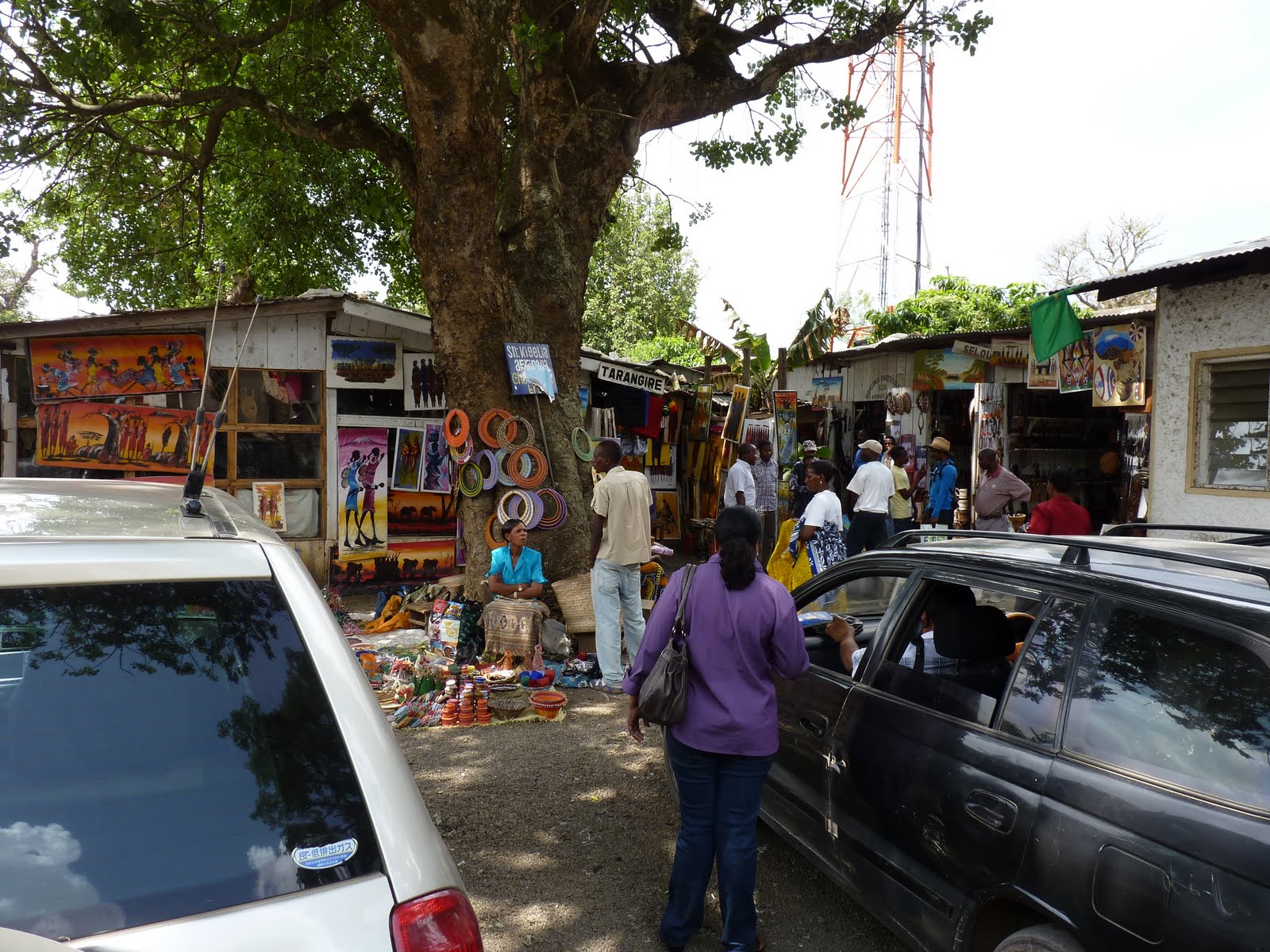
I bought a shirt for myself and some fabric for Elke, she picked up earrings, a beaded choker, a shirt and belt for me and tyre shoes for her son Leland. I looked at and considered many, many baskets, large gourds/calabashes, wooden bowls, beaded bands and earrings, African harps, shakers, mbira and so many different fabrics. Elke tells me to wait till Bagamayo.
This is Arusha, second largest city in Tanzania. We go out for lunch with Seppo our host, his wife Juliet and three yr old son Roni after our shopping experience, then retire to the Arusha Masai Italian restaurant, where Seppo has his Gallery, to sit in the shade and catch up on writing and email. I've had a few meals here since I arrived 6 days ago.
The flight from Amsterdam was much more comfortable, I managed to grab an empty seat at the front didn't watch ANY tv, read, dozed and watched people and the map. (OK so I did watch a screen!) The sun setting over Africa shining through the porthole was quite magnificent. An incredible red stretching across the horizon for about 20 minutes seen from the centre of the plane, took my breath away. The entire traveling was easy other than the time crunched into the seat from Seattle, when I did watch a couple of movies. However I couldn't hear the dialogue. Too bad there wasn't a Swahili language option.
Landing at Kilimanjaro my bags arrived safely, albeit last journey for the red suitcase. US$50 for the Visa, I declared the Gouda I bought for Elke in Amsterdam, stepped through the door and there was Seppo folding out a sign with CM on it. As we walked outside the air, the scents, the temperature embraced me. Africa, I've arrived.
Tuesday, 16 November 2010
Back to the other reality
Clouds rolled in quickly, the wind came up and it rained again in the night. The water had turned that steel grey with chop that can make it challenging to paddle through. Neither of us were all that enthusiastic about leaving as we ate our breakfast and cleaned up the dishes. All the wood I had carried in was stacked beside the stove and a now dying fire. We stuffed dry bags with gear and the remains of the food. I carried it all down as Matthew effortlessly hoisted each kayak and placed them at waters edge.
Already my hands were cold! The wind blowing from the SE meant we were in quarter seas till rounding Saltspring then straight into it to get home. However, as I paddled away jamming my hands into the pogies there seemed to be little wind at all, and once past Jackscrew the water leveled off and it was an easy paddle to the light on the reef by Saltspring.
Paddling back to Tent Island was easy, more giant jellyfish drifting by beneath us and of course seals everywhere. Pulling up on the beach at the north end I recalled the many times I had been there before. In fact the first time a friend took a picture of Matthew's mother and I with the little guy walking along the beach. That picture made it into the paper.

Matthew, impressed by the profusion of Arbutus berries, snaps a picture capturing an eagle. Two more follow checking out what the gulls were feeding on in the channel. Apparently not worth their interest, they returned and perched in a big fir making conversation.
The venting steam from Crofton indicated only a slight breeze so we took our time and Matthew got some shots of the guano stained sandstone on the west face of Tent.

Quite a different colour now that the birds have gone and the rains have come. I find it hard to describe or express the magnificence of the sandstone etched, carved and smoothed by the elements. One of the reasons I find kayaking here so compelling. The physicality of our environment is like an amazing taste of ambrosia or the unexpected touch of one's lover while focused elsewhere.


Meanwhile it was time to go home. Across Stuart Channel, then back under the bridge, the tide high ( I have spent a few occasions dragging my boat through inch deep water cause I didn't check beforehand!). We powered past the men in pfds still loading logs to go offshore. By now the deck was piled high. They found us a strange sight I think, as they stared long and hard while we slipped by towards the boat launch.
Matthew collected the van as I emptied the hatches, so grateful for the adventure and impressed at my lack of soreness. I bought us each a hot drink at the bookstore cafe, tempted as I was by the stacks of unread books, I didn't dare. Back to civilization; traffic, storage lockers, computers and the warm embrace of familiarity, home and community.
Already my hands were cold! The wind blowing from the SE meant we were in quarter seas till rounding Saltspring then straight into it to get home. However, as I paddled away jamming my hands into the pogies there seemed to be little wind at all, and once past Jackscrew the water leveled off and it was an easy paddle to the light on the reef by Saltspring.
Paddling back to Tent Island was easy, more giant jellyfish drifting by beneath us and of course seals everywhere. Pulling up on the beach at the north end I recalled the many times I had been there before. In fact the first time a friend took a picture of Matthew's mother and I with the little guy walking along the beach. That picture made it into the paper.

Matthew, impressed by the profusion of Arbutus berries, snaps a picture capturing an eagle. Two more follow checking out what the gulls were feeding on in the channel. Apparently not worth their interest, they returned and perched in a big fir making conversation.
The venting steam from Crofton indicated only a slight breeze so we took our time and Matthew got some shots of the guano stained sandstone on the west face of Tent.

Quite a different colour now that the birds have gone and the rains have come. I find it hard to describe or express the magnificence of the sandstone etched, carved and smoothed by the elements. One of the reasons I find kayaking here so compelling. The physicality of our environment is like an amazing taste of ambrosia or the unexpected touch of one's lover while focused elsewhere.


Meanwhile it was time to go home. Across Stuart Channel, then back under the bridge, the tide high ( I have spent a few occasions dragging my boat through inch deep water cause I didn't check beforehand!). We powered past the men in pfds still loading logs to go offshore. By now the deck was piled high. They found us a strange sight I think, as they stared long and hard while we slipped by towards the boat launch.
Matthew collected the van as I emptied the hatches, so grateful for the adventure and impressed at my lack of soreness. I bought us each a hot drink at the bookstore cafe, tempted as I was by the stacks of unread books, I didn't dare. Back to civilization; traffic, storage lockers, computers and the warm embrace of familiarity, home and community.
Subscribe to:
Posts (Atom)