Wednesday, 9 April 2014

Homemade micro Hydro

While in Cameroon an opportunity came up to visit the site of a small hydro project in Kugwe near Batibo (the Palm Wine capitol of the world!).
Local engineer  Farmer Tantoh arranged the trip and we wedged ourselves into a crew cab. Elke and I sitting up front, Joram and Tantoh conversing behind us non stop.  Our driver, Divine, quietly   answered our questions; (mostly Elke's) names of towns, items for sale at the side of the road with a little about himself while enjoying his music as we passed through the inevitable checkpoints.
 The road was good, paved within the last 3 years, through rolling hills mostly deforested and covered with grass.  Occasionally we'd dip into a jungle like valley but the majority of terrain around the settlements and villages was small farms. At numerous junctions there would be clusters of motorcycles,  large plastic containers hanging off the back, stacked sideways; 20+litres each, blue and white, empty or filled with mimbo (palm wine) for sale elsewhere, the drivers waiting...

Turning off the pavement we spied a fellow climbing a palm beside the road, his palm stem belt allowing hands free action when trimming the fronds.
The road  began to deteriorate, narrow, more potholed and still we drove on turning eventually down a trail, wheels straddling the twists, turns and contours. Parking amongst a group of houses,  people emerge with great smiles on their faces extending hands to shake and even a few hugs. Adult men mostly, children shyly looking through doorways holding back.
After a few moments of greeting we are immediately underway walking along the path following a line of wire strung up on poles through trees past extensive gardens, swales running down hill, burnt over and in various stages of cultivation. The air is thick with moisture, it's warm and I'm immediately sweating.


The trail descends, crossing a stream, swampy and fetid with decomposing vegetation the air filled with the spicy smell of something blooming.


 It gets steeper, slippery and the men attempt to help me, to stop me from falling as I grasp this or that root, vine or branch.


 We  hear the waterfall and  then stand at the top where they have engineered a sluice-way to pipe the water to the turbine another 50 metres below.
No water runs now, the pipe is punctured. Unfortunately, rocks hurtling down inside have broken the plastic. But for 5 days they did have light in the village.


What effort it  must have taken to haul the pieces and parts down this steep and treacherous slope!


 We continue, handholds necessary as I negotiate the nearly vertical climb and descend onto another small outcropping.


Here they have installed their turbine using a used auto transmission and various mechanical and electrical components.
   It sits now waiting to be reengaged. Ingenious, resourceful and creative, these folks are still positive, hopeful and encouraging.
 Elke and Joram film and interview them standing proudly behind their creation, the waterfall roaring in the background.


Everyone then inches out onto the slippery rocks, another 70 or 100 metres above the last drop and we all pose for "snaps".


On the way back up my shoes seem to fall apart (velcro doesn't like mud), I'm exhausted, recalling in my youth bushwacking through the Devils Club and Salal above Sombrio on West Coast Vancouver Island. Thankfully I've seen nothing here like Devils Club, grabbing whatever I can to haul myself up. Reflecting on my age, I compare myself to these   30-40 year old "young" men who almost daily make their way through this landscape.

 Back at the village I learn that the women, missing from the meal, speeches and mimbo drinking session we enjoy later, are off working their farm/garden plots a 3 hour walk away...


They have big dreams here; to improve their children's chances of success by providing  light so they can study at night,  by creating fish ponds to supplement their diet,  building cabins for visitors to stay and of course to get their electrical system working again as model of what can be done with a little ingenuity and resources at hand.


This experience like many others, inspires me in my exploring, meeting people and assisting where possible as we continue to create a better world for all.

Friday, 28 March 2014

Bookstores


I love bookstores. Wandering the aisles, searching out my favourite classifications to see what the latest author has to offer, browsing the pages of some beautiful coffee table extravaganza. Almost as entertaining and satisfying as visiting a library where I can take those books home! At least briefly.
But here in Bamenda Cameroon, I've had to readjust my assumptions and expectations.
 My experience of bookstores has taken a giant leap... sideways. It's not that there are not bookstores, there are.
Along Commercial Avenue I spotted the Simplicity bookshop, Academic bookstore and College bookstore to name just a few. I had some specific interests I wanted to explore; some technical tomes on indigenous flora, maybe a few local authors  for their perspectives, something about Cameroon itself, local geography, history....

Cue in the sound of the NOT buzzer from some game show.


First of all most of those "bookstores" have a large counter just inside the entrance preventing entry. The few books available are shelved out of reach behind the counter and are either religious or elementary to secondary school texts. And there are precious few of them.


They do have stationary, pens and paper, but are just as likely to be selling; clothing, cookies, onions, appliances or miscellaneous hardware.

As for any technical books... after a long search into every bookstore I saw, we found in one, a few copies of a moth or silverfish eaten agricultural text that seemed too outdated to be useful. Nothing else.

 Across the boulevard are the street vendors, their carts piled high with used and new school texts, photo albums, daily calendars, diaries and scrapbooks.

Browsing here is very different. Each of those used and  sometimes ratty looking paperbacks  represents more forcefully the bottom line for these guys. I'd pick one out and there would be the vendor already to wrap it up and offer me another.

 With patience and some tips from more experienced buyers, I was able to negotiate a better price and find some of what I was searching for. Used of course.

One day I visited one of the local Universities with another volunteer.  Her research had led her to search the stacks in the library there, where we found a text book recently written and published locally by one of the professors at that same  University. Is this book for sale somewhere?
Unfortunately he had passed away, so we asked the fellow there to contact his wife as we wanted to purchase ....
Cue in the buzzer.


Other than those street vendors, and this one in particular, I 'm convinced there is a culture of non engagement with literature here, no one can answer my questions about specific books almost no one even seems to know what I'm talking about!
Case in point , the local "library" The custodians of the books , the librarians, don't seem to know what they have, the card file is not accessible, the books I saw were all donations, out of date, used and abused. They did have a large collection of fashion and political magazines from France...
I won't give up though, I've heard there is a bookstore in Yaounde...

Saturday, 25 January 2014

Looking for Peckinpah Heritage


I have  yearned to know my history. That search for roots on one side of the family has taken me to the likely source of my mother's people in Germany. The first recorded ancestor of a long line now populating the United States from Pennsylvania to California where my mother was born. Thankfully a number of the previous generations had seen fit to explore the archives and records in various North American locales documenting the births, deaths, marriages and possible enterprises undertaken by the family as time proceeded.
Near the centre of Germany where Baden-Württemberg and Hessen  come together is a settlement called Eiterbach, a link to that past individual who chose to leave and eventually stood on the deck of some ship arriving in the new world so long ago. My imagination kicks in frequently as I pursue this thread. Did that family; a  widowed mother, 3 sons and new husband have any idea what to expect? and on arrival to what end did they change the name they'd chosen, carried or ran away with?
The evidence is scanty. But there are threads.
During my time in Germany I was able to arrange a road trip, across the centre and south into the mountainous region of the Oldenwald from where my source had indicated the family in question had fled. A long way from any Autobahn, tucked away in a narrow valley, isolated even now, I cannot (but I'm trying!)  imagine what efforts it might have taken to cover the ground I did in an afternoon on paved roads, 340 years previously.

View Peckinpah Heritage in a larger map Proceeding northwest from Heiligkreusteinach we entered an idyllic and bucolic scene of fields and forest. Small settlements of houses, the occasional farm house perched on the edge of the valley's  north side, I wondered how much had changed since their departure. To the south a stream descended along the bottom of the valley eastward, nearby a Pension offered accommodation. Unfortunately we had a tight timeline. We drove on, then soon turned back as the road began to climb into the mountains. Not a big place.
 The  Neckar river to the south 12 km from Heiligkreusteinach  flows through a gorge there, not a likely route. Our path through the mountains took us south, east, west and north, up, down and around. We followed the smaller river courses and then emerged onto the floodplain of the mighty Rhine flowing north to the Atlantic
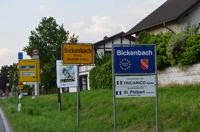
Here we found the name source,  Bickenbach-  Bicken creek, one in series of larger and smaller towns at the base of the hills and mountains stretching back to the Odenwald. For my money, I'd bet one of those castles still standing on the peaks of the foothills was likely the birthplace of our heroine or  her children's godparents.
The locals are happy to cash in on interest in history and those sometimes derelict constructions, the original residents long since gone, leaving little trace of births, deaths, marriages or enterprise on the heels of religious persecution, mercenary soldiers and the changing fortunes time engenders.
There is continual traffic on the river; north to Holland and south into Switzerland. I'm assuming their passage on a barge or river boat was eventful in itself. What choices led those people to leave? To throw away past alliances or investments and gamble on the unknown? I can only guess. From my perspective, it was a tremendous and challenging undertaking for which I have great appreciation and gratitude.

Thursday, 26 December 2013

December 25 2013

As  a traveler I am consistently challenged by my own limitations. Whether it be tolerances or accommodations my underlying internal structure has been determined  by the "slings and arrows" of my conditioning, misfortunate or otherwise. The stimulation of new and foreign, unfamiliar and extraordinary is certainly part of the draw. And yet, perhaps understandably, there is occasionally something missing. Especially on days like today.
Christmas has been a challenging one for years now. A number of conflicting contradictory messages have created confusion and occasional despair.
Beyond the local relevance of this "holiday" what I am missing most is friends, family, my tribe. Even nomads have consistent community. As I understand it, family or tribe is essential for the human social animal to thrive and succeed. Here, now, my community is ephemeral, if it exists at all.  I spend 9 months in this place or that place. I can find a few friends in most situations, we foster connection, but ultimately I am always just passing through.
  Thankfully the internet facilitates friendships and relationships no matter where we are (given access) but nothing beats face to face human contact. I am heartened by my personal correspondence and my affiliation to the ManKind Project (MKP) community.  I wouldn't be where I am now without the leadership, growth and maturity I gained there.
For this seasonal celebration, the gathering of friends and relatives trumps the gift giving (and receiving). The artificial trees, shiny decorations and annual church attendance have little meaning for me. I have yet to see any awareness or celebration of celestial events like the solstice. The daily passage of the sun is relatively consistent. The moon makes it's way from full to new,  the sun rising within a few degrees at the same time everyday. Those earth based, sky focused rituals or ceremonies have likely been stamped out or swallowed up by another set of parameters determining religious belief. The people here seem to have embraced the missionaries message. My beliefs are more aligned with the ancient indigenous than the introduced.
I have created this reality for myself, journeying beyond the frontiers of the familiar both physically and in spirit. The like minded, the sympathetic are with me in my heart. Although my tribe is on Vancouver Island, my family in Canada and, within MKP, a few honourary members throughout the planet,  I am grateful for all my connections, where ever I find community, as they are the very best gift one could receive. Ultimately all the belief systems, differences and arbitrary divisions are irrelevant. The message is, and always has been, about connecting at the heart level.

Friday, 13 December 2013

December 13  2013
I'm sitting here in Bamenda on a cool a grey morning looking out over the town below. The market as usual is busy with taxi's and motorcycles dropping off and picking up people loaded down with packages of things to sell or what they've purchased. From up here it's like watching an anthill peppered with tiny umbrellas, an occasional bus slowly working its way along the edge. Directly below us are houses, compounds mostly made of mud brick covered over with corrugated tin roofs. You can imagine what it sounds like when it rains. These buildings descend like steps, intermingled with bananas, papaya and mango trees down to the market. The sounds of people talking, yelling, banging away on metal, an occasional dog barking, children crying, laughing and playing mingled with loudly broadcast music and the ubiquitous honking goes on into the night daily.
Beyond the market the terrain rises slightly covered with concrete block buildings,  some apartments, but mostly business's. We walk that way frequently going downtown. One whole section is dedicated to car repair, parts and "service" the rusting hulks of cannibalized taxi's, vans and small trucks willy nilly lining the "roads". When it's been raining it is barely navigable on foot, rutted and potholed it turns into a quagmire with all the metal, broken glass and spilled oil unevenly distributed for blocks. The paved street two roads over to the right is like a racetrack, the taxis and motorcycles weaving up and down as the pedestrians squeeze between the parked cars and the live traffic, a constant stream of humanity walking back and forth with goods for sale on their heads, or delivering used car parts, business men in suits and women with babies.
 Not many tourists here, it's almost worth remarking when we see one. Ironically they seldom acknowledge me, some kind of denial that there could be anyone else having this unique experience, I know I've felt it myself, and read about others experiencing and describing it... Read any Pico Iyer? He nails a lot of the traveler's angst and dismay.
Beyond that commercial area up to the left a ridge with more apartment buildings rising up it's slopes and some open land at the top, likely a religious school or church grounds. Almost every educational facility here has Presbyterian or Catholic affiliations. And they seem to own most of the green space, beyond the individual garden plot everyone has to grow their sweet potato, corn or assorted yam varieties.


Behind all that there is more, and more of the same to the north and west but it's framed by cliffs that line the south east edge, houses and compounds climbing to the vertical limits.  We climbed up those slopes a few weeks ago to view one of the waterfalls.


I find it incredible how people can manage to capitalize on the slightest amount of barely level ground and punch in a garden. Although the gardens themselves are not visible from here, I recently saw fires and smoke so assume they are doing slash and burn as we approach the dry season.
Up top in Upstation, the government officials, high rollers and gentry of the place have massive properties with even more massive "houses" among the very old mansions built during and since the Germans were here 100 years ago. Apparently the view up there is spectacular. It was hard to see through all the hedges, walls and fences erected around their properties.
The view from here is pretty amazing, the mountains beyond blocking the sun's rise until 6:45, later lit up as it sets. It's a constantly changing panorama when the smog/mist clears.

I've been reading an old travel guide; this place has tripled in size in ten years; you can well imagine the infrastructure  challenges. The folks next door down below have an outside shower and biffy and put out buckets to collect their water or walk a few blocks to a seemingly public "tap" which I first thought was a leaking waterline. It may be, but recently some enterprising individual poured concrete around the outlet and installed a pipe. Everyday there are kids surrounding it waiting with their used plastic "jerry cans" to fill up and haul off.
The dry time is coming, when the Harmattan blows sand and dust off the Sahara, blocking the sun for days at a time and dropping the temperature.
Not enough for a white Christmas though.


Monday, 25 November 2013

At home in Bamenda

We've been here in Cameroon for 4 months this week.


Housed in the Bamenda guest house of Better World Cameroon, an apartment on the 4th floor above a nightclub at one end and a Pentecostal congregation directly below us. Needless to say there have been some noise issues. Unfortunately, especially bad Sunday mornings when I've been tempted to monkey wrench the large speaker outside the hall below us. Suffice it to say voice lessons would be recommended. Our room turned out to be our host Joshua's. He was gone for a good part of the time, but when he returned we felt it was time to give him back his space.
A search around found some affordable "caves" or moldy walls or way out in the country... I was all for in the country, but practically speaking this time it's an urban(e) experience. Elke found us an airy, light filled apartment at the top of a hill, a 2 minute walk from the office overlooking the food market with a great view to the....? North-east across the town to the cliffs surrounding.
The sun rises over the mountains about 6:45 every morning. Works it's way overhead, shining all day on the south east wall of the building, making for radiant heat into the night. Luckily the bedroom is two rooms away. (Spare room for visitors!) The bathroom though shares that wall, so occasionally, if planned well, I can have a briefly warm shower. This apartment was meant to be an office. We had an extra tap installed next to the toilet to fill buckets, since there is no kitchen sink. Our friends in Better World loaned us some furniture and I ordered a custom made chair of cane with a shorter matching one for Elke. Mine feels like a throne.


A local carpenter came to drill holes in the concrete for hooks and installed a  2 legged table on  a window sill for a counter. He then made us two screens for the windows. We bought some cane "shelving units" for the kitchen and bedroom along with baskets for the miscellaneous.

We splurged on a raffia bed (actually it was cheaper than one of the heavy, overly embellished wooden ones displayed everywhere at the edge of the road) made to order by a local Bafut craftsman. Light, attractive, simple and possibly shippable (!)
The little touches of decoration make such a difference: raffia mats on the floor, fabric hung on the wall to diffuse the echo, locally produced lampshades from gourd and thin iron and (no surprise) more baskets.

We borrowed a "wardrobe" from Joshua (that was a picture, us carrying it up the road  with our backpacks full), but it's really just a frame. Works for hanging our shirts, suits and dresses with the suitcases on top to keep off the dust.
Downstairs an internet provider ran a wire for us and now we have a great connection (we take turns)...when they are closed.
And we have a balcony, now with basil, parsley, tomato, lettuce and the "peaceplant" Dracaena in pots.
We're home for the duration.

Tuesday, 15 October 2013

Sachsen to Niedersachsen


How easy it is to become ensconced somewhere. Some creature comforts, steady access to a seemly endless supply of cheese, meats and bread, not to mention beer and wine and I was ready to settle in. Sort of. Not speaking the language is a major liability and in spite of my dedicated efforts, online learning is not the same as conversation. Our situation began to crack at the seams when the little work there was, dried up.
 Miraculously or so it seemed at the time, we received an invitation to come support, teach and participate in an Eco Village Permaculture Work camp in Cameroon. I had to look in the atlas to find it, google informed  me it was French and English speaking with 200 local indigenous languages. In the Northwest region we will be visiting they speak English.
All that we'll deal with in due course. Wrenching ourselves out of the suite in Sachsen we rented a car and spent most of the afternoon packing it and cleaning up, gracefully exiting south and west towards  the ancestral home of my mothers' people.
Amazingly we managed to get everything ( I thought we were traveling light?) into or onto the car. I had quickly thrown together a roof rack ... the bicycles would not fit inside.
The autobahn's are quite efficient even in the slow lane at 120kph so we allowed serendipity to determine our resting place that night, turning off onto a secondary road driving through potential National Park and deep forest till almost dark. We made a right, drove through an old stone gate and there it was, an ancient Monastery converted to prison and  a hotel beside. Slightly richer than we had planned for, we took a room above the entrance and fell asleep to the sounds of Italian tourists telling stories and laughing into the wee hours.


After a wander through the town of Erbrach and an extended visit with the hotel owner (she reduced our bill!) we were off, lunch included.
 After driving for an hour or so we were finally in the neighbourhood of my ancestors.

 I had a few place names which we investigated as only one can do sitting in a car, but unsurprisingly no traces remained. I did get a feeling for the place, as much as one can 400 years later.


We visited a nearby castle where stopping in the weeds at the side of the road I inadvertently picked up a hitchhiker.


Staying as long as possible on the secondary roads we eventually joined the autobahn, into Frankfurt and the challenge of parking with two tempting bicycles on the roof. Reassembled they spent the night in the backyard locked.
I woke in the morning scratching like crazy from a bite on my leg. Only later did we figure out, I'd picked up a tick....Lyme disease...
Then following the Rhine to our next stop Cologne or as they say it in Deutschland, Köln. An amazing city with some interesting architecture, less worry about the bikes, we locked them to the car and spent two nights in the company of good friends.
 Of course we visited the Cathedral, had beer in typical (small) glasses and took the gondola across the river and autobahn.
 I couldn't help noticing as we drifted over the once Roman spa now modernized a few unclothed sunbathers below.


 I love how bicycles are an important mode of transport here, dedicated bike paths beside the sidewalks, everywhere.
 Münster especially, thousands of bicyclists nearly dominating the traffic scene.


In Bonn we reconnected with a long time friend of Elke's, walked along beside the river and had the universal male ritual of bonding over BBQ in the backyard.
Driving can be hypnotic,  but relentless on the autobahn, the lines of trucks on the outside, the fast drivers on the inside and us weaving back and forth between the three lanes between. So back onto a secondary and past the historic home of my partner, the family name prominently displayed. Her school still stands, although memory made it hard to locate at first.  A short visit with an auntie and a hotel in Bremen for the night.
 Morning found us wandering through her old haunts, reconditioned and spiffed up for the tourist trade. Not far away we stopped at her younger sister's, where we stored the bikes. A late afternoon run into Ahrensburg and then Hamburg, the final stop for the car, returning it in the morning with 10 minutes to spare.
It's amazing to have all that responsibility, and then to let it go.....
Our resting place at the moment a flat landscape excellent for bicycle riding to the trains... to Stade or Hamburg, or Cuxhaven.