Sunday, 20 December 2015

The Fon's dance

Once a year the Fon (King or traditional leader) of Bafut hosts an amazing cultural festival the Bafut “Abin”. We have attended now 3 times and this year I danced. Finally!
 The official invitation  includes lunch with the Fon held on a grassy meadow below a massive tree to the left of the museum. At the top of the stairs to the museum, a guard let us through the gate. Chairs were spread along the stone fence overlooking the parade grounds and parking where the dance would take place. We arrived well after the stated start time and waited patiently for his highness, and everyone else to appear.
 When the Fon appears everyone  must stand, till he is seated, and the same when he leaves, till he’s out of sight. He sat flanked by his retainers in their tie dyed indigo ceremonial cloth “skirts”, shirtless, each holding a  2 metre spear.

To his right facing us (sort of, he was behind a small tree) dignitaries are placed according to some formula. Most of them know not to arrive too early, some managing to arrive as they were called up to eat into the serving line.
We sat in the shade, under a canopy till it was our turn to be called up.  The Princesses in traditional attire walked past and an almost endless procession of robed and hatted elites, relatives and invitees arrived. Beer was the chief liquid refreshment although there were also a variety of flavoured  bottled bubbling beverages available.
We were entertained by a local photographer tour guide, who found us to be interesting subjects dressed as we were in traditional clothing. This year I intentionally left my camera behind. Last year I spent most of the event staring through the viewfinder or at the display screen, attempting to capture the pageantry, sumptuous fabrics and embroidery  swirling around me.
It was not so bad at the festival, but I’ve experiencing some challenges taking pictures. The locals never seem to have an issue but my white face brings out resistance and demands for payment.

A number of familiar faces drifted by and we greeted and were greeted ourselves by old acquaintances and friends. This is a well attended opportunity to see and be seen, an annual gathering of the tribes. Family groups, dance groups and the like wearing similar fabrics, designating that they were representing some faction of the populace.
Once lunch was done we stepped out to sit together in one of the local bars while the traditional rites took place. Outside a continuous parade of brightly coloured robes and dresses passed by in the bright sunlight. A vendor came in and I bought a(nother!) hat. I’d noticed most men had a new one each year, so…
I spotted a group going past with swords, spears and bows and arrows so we finished our beers and wandered back through the throng. The crowd was growing, the bandstand full. We positioned ourselves in front of the sacred drum and watched a group slowly make it’s way towards us from the palace, beating drums and playing flutes.
The Fon and the Mayor stood out and blasted away with shotguns,
then the first group came chanting, brandishing weapons and posturing  to stand in front of the Fon and his party. The point of it all is to show they are fierce enough to protect and support the Fondom from attack. Pledging allegiance. But this year no other guns were fired and there were fewer groups or quarters represented.
And then the Fon  began leading a group of notables in the beginning of the dance. He made a small circuit, then sat down to watch. The drummers had maintained their rhythm and moved in closer to the centre.
As the Princesses passed by in a long line  sweeping their horse hair fly wisks in time with the beat, other folks tagged on. I was grooving to the beat and it just seemed natural to step in and follow along, with my cane in hand. The woman ahead of me was impressed and guided me through as we circled in a long oval past the spectators ringing the procession. Numerous cameras and cellphones caught me as I slowly shuffled along. As we approached the shrine she told me to face it as we danced past.
 As I passed the royal party, first the mayor and then the Fon , along with a number of dignitaries,  acknowledged me with raised fists or canes. I was able to respond in kind by lifting my cane.

After 3 or 4 passes both my guide and I were done and  we melted back into the crowd. As best I could anyway, being one of about 9 white faces in a sea of Bafut Cameroonians.
An incredible spectacle, I felt like a Bafut man dancing with the people.

Sunday, 13 December 2015

Bamenda journal

After some soul searching and reality checks we’ve decided to continue living in town. The apartment building is familiar (our third time living here) and central. Step out the front entrance (there is no rear entrance unless I get us a rope ladder)
and it’s easy to catch a taxi going by in either direction. We usually walk though, right, to the Better World office towards Bafut or down Fish Pond Hill to the food market below. To the left goes down past the hospital to get to Commercial avenue or  to French lessons at Veterinary junction.
 This Saturday morning we made our way down the hill for weekend shopping and entertainment. It’s  an engaging descent as taxis and motorcycles laden with all manner of goods hurtle uphill and down often spewing noxious fumes. Both sides of the road there are tradesmen and  small industry making aluminum cooking pots, cement bricks and furniture . At the bottom the road crosses a stream choked with detritus and garbage, plastic, tires and discarded baskets from the market. Upstream, I saw a fellow washing himself.
 It's a busy time, the food market  packed with vendors and buyers, the motorcycle drivers congregating at the corner like vultures, waiting for fares. Crossing the road can be challenging although there is so much traffic and the road is so narrow it is often at a standstill.  The roadsides lined with vendors hawking wheelbarrows full of peppers, groundnuts, onions and oranges, the stalls behind with almost everything else.

We continued on past trays and carts of kola nut, potatoes and stacks of eggs to the fish market (all frozen). Then parallel to the main road up an alley past piles of new flip flops and many little kiosks  with used shoes hanging from strings.
Beyond this is the “clothing district” small booths and stalls shoulder to shoulder along a narrow winding track, densely packed with people, motorcycles honking as they make their way ferrying folks and goods up and down. The whole while in an endless cacophony all these vendors are yelling, calling out, some with repeating recorded messages,”one thousand for pants, one thousand for shirts”.  Piles of used jeans, towels and sheets, hats, new and used underwear. We round a corner past stacks of aluminum pots from big to much bigger, stone grinders, plastic utensils, curtains and used purses. The road was almost impassable, trucks offloading and motorcycles squeezing past the pedestrians and cart boys flogging drinks and snacks.
One had a sign: Special Sale, his cart filled with wines and hard stuff. Apparently no liquor licence required.
 Inside the main market it is laid out in a grid,  a mini medina with darkened passageways running East West and open alleys North South.  From cutlery to contraband I imagine it’s all available. We entered the main entrance off Commercial avenue specifically to see the fabric. Immediately to the right a wide passage of hole in the wall rooms, both sides, with layers of brightly coloured printed fabrics hung out in front. Inside the walls are lined with them, floor to ceiling, piles in the corners. It is almost too much.... I’d like one of each please.
Seriously, it becomes so overstimulating I have stop and focus on what I might use it for…

 In the other direction past the entrance there are three alleys of mostly women producing clothing, sitting at their sewing machines surrounded by the already created shirts, suits and dresses inside and out of their individual workstations. Taking pictures can be challenging. The locals do it all the time but as soon as I point, they want money or they object.
This day though, we were done, and walked out without looking at the clothing. Outside the vendors along Commercial line both sides of the sidewalk in front of the market. We picked our way through then  down the road to a small juice bar where we had a salad, a guava juice and reflected on our next moves.


Friday, 4 December 2015

Integrity, culture and service

Not so long ago I returned to Vancouver Island and North American culture from an extended time in Europe and Africa. My partner and I moved onto the land at OUR Ecovillage  to contribute our experience and wisdom into the mix of people there who have come to learn and grow.  It was a bitter sweet reconciliation for me. Back among both new and familiar friends, family and flora I was eager to apply what knowledge I had of land stewardship and husbandry to assist in the creation of new ways of being. After being away it was refreshing to know the trees, see connections and recognize an ecosystem’s elements. It was exciting to fit in so well, sharing accumulated knowledge with open and receptive minds.
After some time I became discouraged. Not because of who or what is possible or imagined at the ecovillage but by the forces that would prevent or discourage those changes, those possibilities. I  saw through a different lens the incredible amount of energy, resources, time and mental space necessary to live in North American culture. The racism, sexism, ageism and blatant disregard by those with all the money or power, was if not in the best sense of the word enlightening, incredibly disgusting and stressful to me.
 In order for this society to exist as it is, millions, billions of people live in abject mind numbing poverty. Every time I got in the truck to drive somewhere, out on an errand or for some recreational activity it came to me. How easy it was to justify. Except I don’t recall previously needing to justify it. Like virginity, once the experience has happened there is no return. I have knowledge and experience that affects my perspective forevermore.
 I had conversations with myself about my personal integrity. Reflecting on the folks in Cameroon whose income could be measured in pennies to our dollars.
At one point I saw a souped up 30’s roadster painted bright orange cruising down the highway. What I make up, is that some (likely male) individual has a hobby restoring these things, then drives around  to show it off or whatever. They have privilege, partly due to hard work creating income and a comfortable life, but also thanks to a system set up to encourage promote and sustain growth and consumerism. For the rest of the world who all seem to want this “success" unaware of the consequences, there is a massive disparity of value. I see it tied to the incredible complexity of modern societies. Something, someone has to pay for this. The levels of bureaucracy,  the myriad relationships to manifest all those “affordable" consumer goods,  the employment opportunities,  the communication networks and the endless disposable “toys”.
 My time in Cameroon and Tanzania opened my eyes.  We are all under the influence of the corporautocracy. I call it corp-hypocrisy.  I don’t like the direction things are going politically in North America.  It seems out of control and everyone (for the most part) is like the frog in the frying pan, the heat slowly rising.
 From a distance and on social media many are saying it has to change, the end is near, read this etc. Having an opinion is great but posting isn’t enough. I need to put my words and actions in alignment and motion by living what I believe, being the change.
I get that flying in airplanes contributes to climate change, after all, everything is related.  I’m willing to make that compromise in order to do  service in Bafut Cameroon, where I feel more in alignment with living from a permaculture perspective; contributing my wisdom and experience while being challenged and learning from the environment and people there.
 Maybe I’m delusional. But the shadow of that is that I believe most North Americans ARE  delusional, thinking their rate of consumption is sustainable or has no impact. And the reality is that the small things we do pale in comparison to the mega projects creating mass pollution from the petro chemical  plastics industries, throwaway cellphones and non-stop production of new vehicles to name just a few.
 There are 7 billion people and counting on the planet. In various places in the world due to an inherent desire for more, people are dying in civil wars, they are exploited, enslaved and abused, used up and thrown on the trash heaps of our societies. I don’t feel comfortable or in integrity with that cultural construct.
Living in harmony and balance is ultimately the goal, at least for me. Sharing the surplus, taking care of each other and  creating no waste are all part of this. Applying and living with these ethics goes a long way towards an equitable existence. My observation skills improve in application; everything is related, every function in every ecosystem supports the whole, supporting the planet. Working WITH is easier than altering existing systems. Patience pays off in allowing the systems to express themselves. The diversity of the edge is where things are really transformative and greater possibilities exist. I  can apply this understanding in all earth based experiences and possibly mechanistic and technical situations. I can change the world, along with supportive community where ever I find it.

Tuesday, 1 December 2015

Field trip on the Ring Road-Menchum Falls- Bafut to Befang and back

After some time the city, meetings, research and visits to the farm aren’t enough. We want to see some of this country so called a friendly taxi driver to take us on a tour.
 First stop the Bafut market to pick up a few snacks. Then to a nearby bar for some white mimbo or palm wine followed by a stop at a spring for some fresh water.
The road out of Bafut is dusty, clouds of it settling on the bananas turning their leaves red, Potholed and rough in places we swayed back and forth as Eric the driver negotiated each stretch and avoided oncoming trucks and minivans. The road twists and turns into valleys, around mountains,  past villages and farms. These smallholdings with minimalist rectangular redbrick buildings, unplastered and roofed with corrugated “zinc”line the road between sections of forest and  field. Often there were children and occasional adults staring as we drove past.  Upon spotting our faces the children would chant “whiteman, whiteman” to which I, as often as possible, waved in reply.
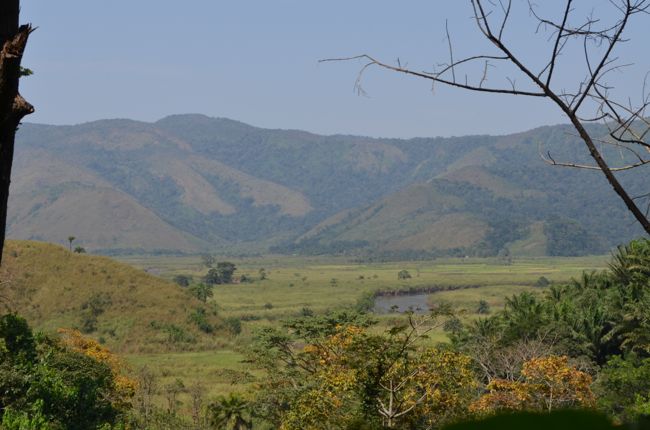
The road began to descend, briefly became paved and as we approached each corner Eric honked a warning. Often there were great holes, missing pavement, bone jarring drops and it wasn’t always possible to avoid them. But the terrain was spectacular, miles of mostly untouched tropical forest the mountains draped in shades of green punctuated with flashes of orange and red flowers. Valley and hill as far as the eyes could see without any evidence of cultivation.This is the sacred Bafut forest, protecting the watersheds and vegetal heritage of the kingdom. Unfortunately for the photographers it wasn’t possible to stop, although that narrow view seldom expresses the majesty and verdant fecundity of the scene.As the road again levelled out we crossed over the  Menchum river and  entered a broad valley.
Rice growing alluvial landscape, fields separated by ditches and flapping clothing suspended on sticks to scare away the birds. The elephant grass easily 3 metres tall where it wasn’t hacked down and piled beside the road. There were numerous highly rutted access roads down to the water where young men and boys poled their broad canoe shaped boats back and forth.

The boys dive down with buckets, scoop the sand into the boats then shovel it onto shore to be loaded later into trucks and transported to Bamenda. For a brief while we were tailed by one of the trucks, coming up behind us as we scraped our way out of one of the biggest potholes I’ve ever been in. The side of the road even with the windows of the taxi. Definitely don’t try this in the rainy season.
I attempted to take notes on this trip, writing the occasional undecipherable word as we careened and bumped along till pavement appeared again. Eric would then accelerate till the pavement gave way while I attempted to read the occasional sign naming each village.


It was quite warm in the car, the mimbo in the recycled soda bottles continuing to ferment, building up  pressure. We had the windows open but every passing vehicle would raise such clouds of dust we were rolling them up in  fruitless attempts to keep it out.
Crossing the river again we came into an area of grasslands, the rolling mountains denuded of trees except in the narrow clefts and valleys between hills.
 Then again beside the river and arrival at the falls.
  Just below the road is a small picnic area and viewing spot with a cement fence to keep folks back from the sheer drop.
 Impressive.
 A tremendous amount of water cascades down with incredible turbulence sending spray out  from top to bottom. Not much if anything would survive that fall. We stepped back and enjoyed our picnic, slowly releasing the pressure on the  warm mimbo  till we could drink it.


Then a short drive down to the crossroads at Befang; north to Wum and west to Benakuma.


By this time we’d had enough of the driving and chose to turn around.

 Stopped at the top of the falls to wet our faces and watch the boys shovel sand from boat to shore.


And again at the bailey bridge to take pictures,  then caught a few views as we climbed out of the valley  on our way towards Bafut.
 The road was not any less bumpy on the return.

Tuesday, 11 November 2014

Buea to Bamenda

The generosity and friendliness of Cameroonian people is remarkable. Our hostess in Buea, Rose, arrived early to drive us to the bus on Sunday morning herself, dispensing with her driver so she could attend church. Traffic was light and after unloading all our baggage we thanked her for her  kindness promising to stay in touch.
 Busses here are an adventure by themselves. Our 8 o’clock departure  actually left at 10 what with loading everyones' bags, root crops, furniture: a couch and two matching stuffed chairs. (Moving van? whats that? )  on the roof. Passengers getting on and off, buying food and water for the trip and  possibly reselling tickets for already sold seats. Likely the folks who arrived with their complete kitchen cabinets, disassembled but well past the projected departure time, wanting their kitchen pieces piled on top of the now tarped and ready to go pile will be taking a later bus.
We had purchased tickets for front seats assuming, incorrectly there would be more leg room. That seat is beside the passenger door where everyone who enters the back of the bus must rest their arms as they haul themselves over the folding seats between seats where one expects an aisle…. So in the case of a quick exit it might be advised to use a window. However.
When we finally left, behind us a fellow stood in the entrance preaching away until the next stop, (barely 15 minutes) where he collected coins and exited the bus. At first I thought he was giving a safety speech, but he never stopped talking and the frequent insertion of Jesus, Almighty Father and other familiar expressions soon cleared up that misunderstanding.
The moment the bus stops there are women children and young men hawking things at the windows. Squared loaves of white bread mostly, groundnuts, bottles of pop, boiled eggs and occasionally bananas. Further north we were offered tangerines, kola nuts, more white bread and bobolo: thin sausages of cassava  wrapped  in banana leaf. Mostly tasteless, the consistency of rubber,  a translucent worm of starch accompanying most street food here.
As the bus motored on we passed through numerous towns, police checks and some spectacular scenery climbing from a broad valley switch-backing up a bamboo covered mountain. Even on this steep hillside folks are carving out their farms to grow what food they can. Much of the countryside has been transformed by people cutting down the trees to grow corn and cassava.
Sitting up front we had a great view of approaching buses and trucks, like the fuel carrier apparently leaking/spraying (I hope ) diesel on our windscreen. I was surprised the driver, when we finally stopped for a bathroom and food break, didn’t bother cleaning it off.
There were a few scary moments as approaching passing cars and trucks swerved last minute back into there lane and when our driver suddenly swerved off the road as an even bigger bus passed us while another equally large bus approached in the opposite lane the whole busload heaved a sigh of relief.
The last 40 km were the longest. I have never seen a road in such bad shape to a major destination. This is the route,  only way into Bamenda from the south. Every bus, freight truck and I assume any government officials must travel this potholed, bone cracking, jerky excuse for a road. It took us almost two hours to finally reach our destination. Darkness fell and we hauled our bags off to the side as it began to rain which then erupted into a drenching downpour. Welcome to Bamenda!

Monday, 10 November 2014

Return to Cameroon

When the call comes it can be a surprise. On the eve before our morning departure, it was an sms/text message informing us our flight was cancelled.  As the message was less than illuminating, which flight? Morning or night? I called the airline.  A recorded message.
Thankfully I’ve become somewhat obsessive about packing. Most of it was done. Only the daily necessaries, toothbrush, bedding clothes for the trip and reading material still strewn about the room. We bussed out to the airport and spoke with an agent there.  Her eyes welled up, she composed herself, then expressed appreciation for us actually showing up and not ragging on her. We had two and half hours to get back, finish packing  and return for the 8pm flight to Brussels. Hotel room provided.
Landing in Douala the heat enveloped me like a wet blanket. What breeze there was blowing in the “windows” was warmer than warm. We trudged along the passage turning right, left and then down a long hallway,  then right again into a narrow booth where a fellow read our temperature… no Ebola here. Just around the next corner we entered a construction zone where the mass of people spread out into three indistinct lines creeping slowly through customs and immigration. I was at first pissed and resentful as two white guys basically forced their way through from the back past us all, then let it go and relaxed into patience.
Approaching the luggage carousel I wrestled off three of our bags,  and as the crowd thinned, waiting for the last one, imagined a number of dire scenarios. Thankfully all was well with the luggage angels… With help we managed to exit the building, everything intact to our ride waiting outside.
By this time it was dark. Rose our hostess had come with her driver to take us to Buea and  after greeting her we managed to jam our luggage and ourselves into the car.  But first a small “tip” to the fellow who negotiated past all the hawkers and touts crowding the exits.
Traffic here can be challenging with taxis hurtling past in either direction on either side and motorcycle taxis driving without due care and attention in all directions at all times. The bridge we needed to cross was a mere two lanes.  Crawling along bumper to bumper, three lanes deep, drivers would switch lanes pushing their way from one to the other when the smallest of openings appeared.
Once past the bridge I spied a large crowd of,  I assume, sports minded men doing jumping jacks surrounded by hundreds of …spectators? There were people everywhere, crossing the road, walking beside, joggers and folks having their evening meal, mothers with babies hauling bundles home and where possible everyone driving as fast as the road would allow.
Did I mention cracks in the road? Potholes in the pavement  big enough to lose luggage into?
After leaving the city proper the traffic thinned considerably and flashes of lightening lit up the sky. We cruised past miles of banana and rubber plantations and not much else till the outskirts of Buea.
 At our hotel  we took a short walk to stretch our legs and find some food and a drink. Nothing like a beer to sooth the frayed nerves and transition into another culture.
 In the morning  I extracted local currency from an ATM (neglecting to count zeros I took out 20,000 instead of 200,000) Then a walkabout with Rose, taking pictures with our now semi functioning camera (do not spill lime plaster on your camera). We managed to get a video interview recorded then trucked up the hillside to sit under cover as the skies opened up in a typical tropical downpour.
Later after securing our bus tickets to Bamenda I revisited the ATM and we were on our own for lunch.
 A slow walk up the main drag, a taxi back to the hotel and then a Cameroonian German style beer sweetened the fading light.  We ate dinner on the balcony, watching the local night life; Taxis honking, picking up and disgorging passengers and the endless stream of walkers.

Wednesday, 13 August 2014

Struggles

I’m struggling with an understanding of our continued survival on the planet. Our species has fouled the nest in ways I cannot begin to fathom, the number of interventions necessary to remediate or transform go beyond my comprehension. This reaches deep into every facet of our existence at every level of engagement. The common thread that ties it all together is denial.
 "The human mind has a primitive ego defense mechanism that negates all realities that produce too much stress for the brain to handle. It's called 'denial" (Dan Brown Inferno)
 It is here, it is now, this is no dystopian fiction. This is real, this is happening and if we do not address it yesterday, everything is going, going gone!
Like many others I continue with business as usual because I’m unable to fully assimilate the gravity and intensity of the doom scenario. I step forward with optimism and enthusiasm because if I don’t, I have given up.
I choose to proceed towards life on purpose, in balance and relational harmony.
Whatever happens our relationships will be essential. They always have been but over time I have taken things for granted; I’m ignorant of the profound consequences sometimes. I have not thought through  all the process, the networks the interrelations. Also, some of theses relationships have been neglected, due to the complexity and our collective ignorance of those systems.
Every action I take has consequences beyond my awareness. The relationships I have with people, food, transportation systems, my immediate and extended environment, climate and water are impacted by my choices.
When I throw something away, where is ‘away”?
 I feel a deep despair at times and grief, for what could be, what’s been lost and how I am dealing with it.
“grief isn't about feeling guilty about what human beings have done to the earth.
"Last time I checked, guilt is not an enabler of anything but self-hatred. Our current regime of self-hatred, or misanthropy, is simply the incarnation of self-absorption."
….. Grief is the ability to see things for what they truly are…”  Stephen Jenkinson

 My responsibility lies with my conscious choices, the unknown I can only hope to address with good intention.
This is an opportunity to create. To network, to connect,  to work in concert, sustain harmonies of spirit, humanity, sound, thought and resonance. Together.
Sometimes the fear of vulnerability, the perceived shame of needing help or looking weak has held me back. This is not the time to succumb to that evocative siren call of withdrawal.
 No.
 Friends, family, compatriots, brothers and sisters, it is time to stand up courageously, to weather the storms of discomfort, dis ease, and disinformation and strive together to transform, recreate and manifest a future and existence that honours all life, That respects the earth in all it’s splendour, celebrates the humility as well as the brilliance of our accomplishments. We share the air and water with all other forms of life, the machinations and grinding processes of earth movements, volcanic eruption and lunar gravity. We know so much and so little. Can we align our thoughts, our hopes and aspirations in one focused inspiring direction?
Yes we can.